God in the Bowling Alley Doorway
I don’t remember the exact moment the fear settled in — not as an emotion, but as a companion. It didn’t arrive with sirens or screams. It wasn’t immediate. Trauma rarely is. It’s a slow leak in the system, a steady rewiring of the senses. One day you’re a child, laughing, trusting, moving through the world like it was made for you. The next, you’re not. You’re watchful. You’re sharp. You’re scanning. Your body is alert to dangers no one else notices. And people call you “mature for your age,” not realizing what it cost you to survive that way.
That was me.
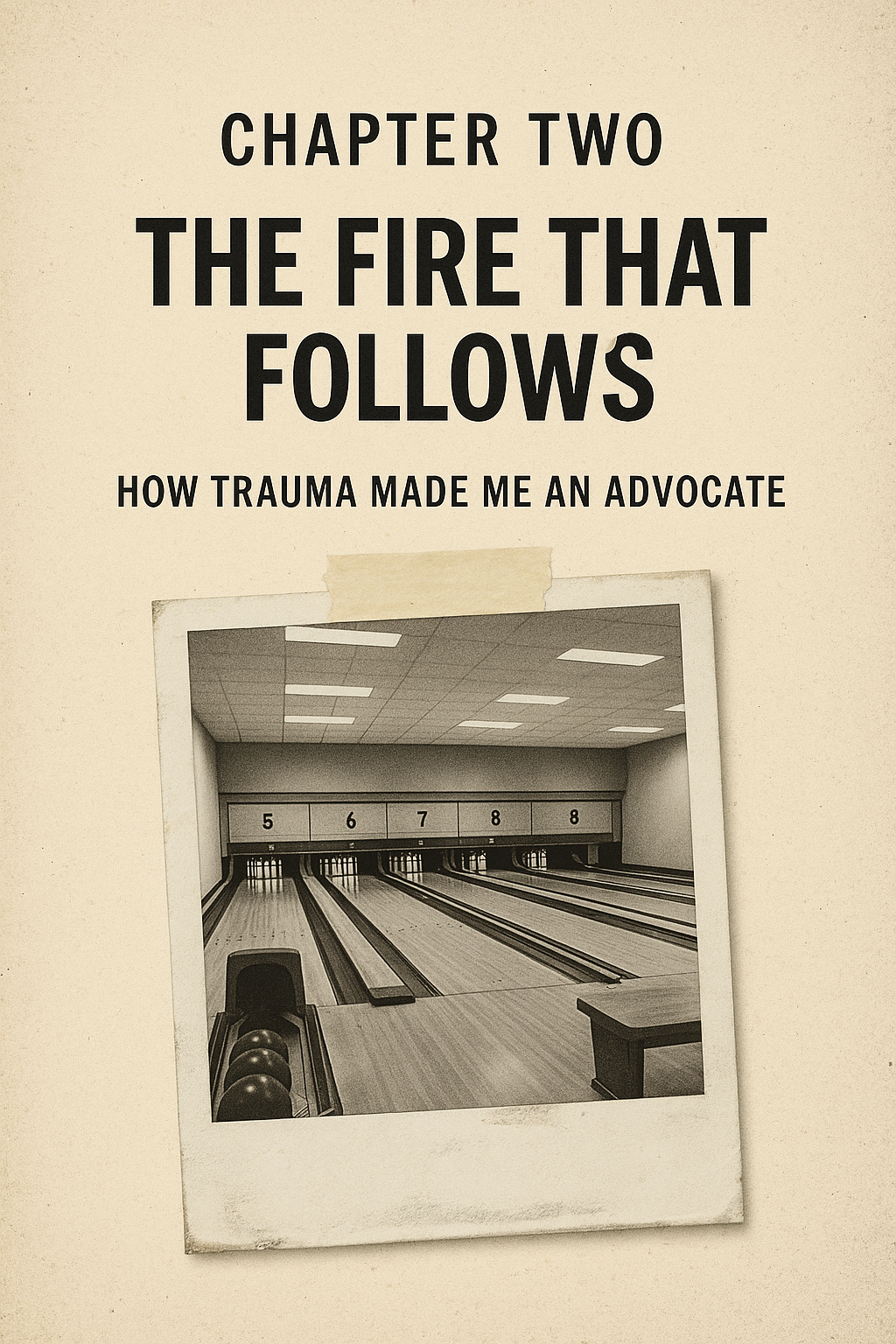
And it started the night God pulled me back from the edge of something I didn’t even understand. The night in the bowling alley. The doorway. The popcorn. The man. The moment my world split into before and after.
No one tells you that trauma has a half-life. It decays slowly but never fully vanishes. Even when you think you’re past it, it lingers. It alters the chemical language of your brain, recalibrates your nervous system, changes your sense of time, memory, connection. For a long time, I lived like that — with a trauma-shaped lens. But over the years, something else began to emerge beneath the surface of the hypervigilance and anxiety. A calling.
What started as fear eventually became fire.
And that fire?
It became advocacy.
When a child experiences trauma, especially at the hands of an adult, their entire sense of safety collapses. The very people and places that were supposed to protect them become proof that the world cannot be trusted. The brain takes note.
According to the Centers for Disease Control and Prevention (CDC), more than 61% of adults in the U.S. report having experienced at least one Adverse Childhood Experience (ACE) — which includes abuse, neglect, and household dysfunction. But ACEs aren’t just unfortunate events. They leave behind real, measurable damage.
Studies show that trauma:
- Increases activity in the amygdala, the brain’s fear center
- Shrinks the hippocampus, responsible for memory and learning
- Impairs development of the prefrontal cortex, which controls decision-making and impulse regulation
- Dysregulates the nervous system, leading to a constant fight-flight-freeze state
This means that trauma literally reshapes the brain. Not metaphorically. Not emotionally. But physically. A child like me — who experienced the moment of near-abduction, the confusion of the predator’s charm, the terror in my father’s voice — doesn’t just walk away unscathed. I walked away altered.
My body didn’t forget.
Even when I tried to.
For years, I didn’t realize that the trauma I carried had started guiding my life. At first, it looked like anxiety. Startle responses. Obsessive checking. The inability to sleep without knowing every door was locked — not just locked, but double-checked, tested, watched. I didn’t have words for it, but I knew I wasn’t the same girl who had once skipped through the bowling alley with a bag of popcorn and a soft heart.
I also didn’t realize that the hyper-attunement — that need to assess everyone’s motives, every glance, every shift in the room — would become my superpower.
Because hypervigilance, when healed and harnessed, becomes discernment.
Fear, when refined, becomes clarity.
And survival, when surrendered to purpose, becomes calling.
Even in school, I remember sticking up for the outcast. The girl with no friends. The boy whose parents were rumored to be addicts. The teacher who everyone mocked behind her back. Something in me couldn’t let silence stand. I didn’t have the language for injustice. I just knew when something felt wrong, I couldn’t look away.
As I grew older, that instinct didn’t fade — it deepened. I gravitated toward volunteer roles, social justice issues, stories of survivors. I remember being fourteen and reading an article about a missing girl — one I’d never met, whose photo appeared in a magazine — and being unable to stop crying. My mother thought I was being sensitive.
She was right.
But it wasn’t just sadness.
It was recognition.
Something in me already knew what it meant to be close to the edge. And something in me, even then, was starting to whisper: You were spared for a reason. Don’t waste it.
Trauma didn’t just make me cautious. It made me awake. It gave me x-ray vision — the ability to see sadness hiding behind a smile, danger beneath a kind voice. It taught me that evil doesn’t always arrive snarling. Sometimes, it shows up polite and familiar. That awareness became my baseline. But it also cost me things.
It stole ease.
It stole spontaneity.
It made joy feel suspicious.
It made trust an obstacle course.
Still, it gave me something in return: a voice.
I remember the first time I stood in a courtroom to speak on someone else’s behalf. I wasn’t even out of college. A friend had been assaulted, and the system — slow and skeptical — was dragging its feet. I wasn’t her lawyer. I wasn’t her therapist. I was just the only one willing to stand up and say, “I believe her.”
It wasn’t eloquent. It wasn’t dramatic. But it lit something in me that never dimmed again.
From there, the path kept unfolding.
I mentored at-risk teens.
I spoke at events.
I helped women leave abusive relationships.
I prayed in hospital rooms and homeless shelters.
I learned how to advocate inside systems designed to ignore.
But it wasn’t until Melissa Witt’s case that my advocacy found its home.
Her photo came to me on an ordinary day. I wasn’t looking for her. I was researching another missing person’s case when her name appeared, almost quietly, almost politely — as if God had slipped it in front of me, mid-scroll, whispering, Remember This one.
She was nineteen.
She was beautiful.
She disappeared from a bowling alley.
She never made it inside.
And I couldn’t stop staring at her photo.
The symmetry between us was too sharp to ignore.
The location. The age. The ordinariness of the night.
I walked away from my bowling alley.
She never did.
That was the moment my general passion for justice became something much more focused: advocacy for the missing and murdered.
And I knew, instantly, in my spirit — this is why I survived.
The missing don’t get enough airtime. They don’t get enough urgency. Their cases gather dust while newer headlines dominate the news cycle. And when it comes to women — especially women of color, LGBTQ+ women, or women from low-income communities — the silence grows even louder.
- More than 600,000 people go missing each year in the U.S.
- As of recent reports, there are over 100,000 active missing persons cases
- Nearly 40% of those are people of color, despite being just 13% of the population
- According to the FBI, there were 95,000 active missing person files in 2024
- Women and girls make up the majority of long-term missing cases
And yet — most people can only name a handful.
The stories get buried. The girls get blamed. The mothers get silenced. And over time, we stop seeing them as people, and start seeing them as “statistics.”
But every missing person is someone’s child.
Someone’s sister.
Someone’s Melissa.
When I first began researching cases, I thought it might harden me. That staring into so much darkness would eventually dull my compassion. But the opposite happened. The more I read, the more I burned. Because every story reminded me of someone like me. Someone like Melissa. Someone like us.
Take Elizabeth Smart, kidnapped from her bedroom at 14. She endured nine months of abuse and emerged not just alive — but relentless. Today, she runs the Elizabeth Smart Foundation, working to educate and empower survivors of abduction and sexual exploitation.
Take Jaycee Dugard, kidnapped at 11 and held captive for 18 years. She was raped, brainwashed, isolated — and yet, after rescue, she became an advocate for trauma recovery, founding the JAYC Foundation to help other survivors navigate the long, complex road of healing.
Take Cyntoia Brown, a trafficking victim criminalized for defending herself. She was sentenced to life in prison at 16. But after years of advocacy from others — and eventually herself — she was granted clemency. Now, she fights for criminal justice reform and speaks on behalf of exploited youth.
These women didn’t just survive trauma. They built platforms out of it.
They didn’t just reclaim their own voices — they became voices for the voiceless.
And I saw myself in all of them.
To advocate is to ache.
You don’t get to be numb. You don’t get to look away. You carry names inside your chest like unfinished prayers. You walk into conversations knowing you’ll be dismissed, diminished, accused of being “too emotional.”
But you keep going.
Because these stories matter.
Because these women matter.
Because silence is not an option anymore.
Looking back, I realize I’ve always been speaking for someone. Always standing in the gap. But now, my voice has a name behind it. A face. A mission.
Melissa Witt.
She is the echo that keeps me up at night.
The girl I didn’t get to save — but refuse to forget.
She wasn’t the first missing woman I learned about. But she was the first one I felt God assign to me.
And I took that assignment seriously.
Because the moment I saw her photo, I stopped being a general advocate.
And I became a vocal, relentless, unapologetic servant to justice.
This anatomy of a calling doesn’t begin with clarity. It begins with ache.
It begins with a girl who saw evil up close.
A girl whose body learned how to flinch, how to run, how to analyze.
A girl who couldn’t forget what it felt like to be seen as prey.
It continues with fire.
With stories that refuse to let you sleep.
With names that become part of your bloodstream.
It’s messy.
It’s costly.
It’s sacred.
I write. I speak. I dig. I post. I pray. I pace. I whisper names under my breath in grocery stores and laundromats and school pickup lines because I refuse to forget. I research cases that have gone cold, not because I think I’m a hero — but because someone has to remember what justice forgot.
I carry names like a rosary.
I listen to stories the world has stopped telling.
I show up in places that ask you to stay silent — and I speak anyway.
And I do it because I know what it’s like to walk away from a doorway when someone else didn’t.
I don’t know what this road will cost me.
I only know what silence already cost the girls who never got to come home.