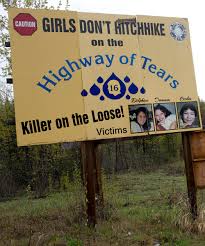
Not Forgotten, Not Silent: The Highway That Became a Graveyard
On maps it looks like a simple stretch of highway—just 450 miles of asphalt cutting west across northern British Columbia, from Prince George to Prince Rupert.
But if you listen to the families who live along that corridor, you’ll hear a different name:
The Highway of Tears.
This road isn’t just geography. It’s a crime scene that runs for hundreds of miles, a symbol of how easily Indigenous women and girls can vanish in plain sight—and how slowly systems move when those lives go missing.
As someone who works in the world of missing and murdered Indigenous people, I wanted to understand why this highway has become infamous, and what its story says about the systems that are still failing us.
This is what I found.
The “Highway of Tears” refers to a roughly 719-kilometer (about 450-mile) corridor of Highway 16 in northern British Columbia, between Prince George and Prince Rupert. The road was completed in 1969; the first known disappearance along it dates to that same period.
The name itself came later. In 1998, during a vigil in Terrace, British Columbia, a woman named Florence Naziel coined the phrase “Highway of Tears,” thinking of the families grieving the daughters, sisters, and aunties who never came home.
Officially, the Royal Canadian Mounted Police (RCMP) created a task force—Project E-Pana—to examine a cluster of unsolved murders and disappearances of women and girls linked to Highway 16 and nearby highways. When the task force expanded in 2007, it took ownership of 18 cases involving female victims who disappeared or were found murdered between 1969 and 2006.
But those 18 cases are just the tip of the iceberg.
Indigenous communities, families, and advocates say the real number of missing and murdered women connected to the Highway of Tears corridor is far higher—40, 50, or even more—depending on which radius and time frame you use. Some estimates, looking more broadly at the region and timeframe, put the number of victims at 80+.
The truth is chillingly simple: some women were never officially recorded, some cases were never linked, and too many were never investigated with urgency in the first place.
To understand the Highway of Tears, you have to understand the landscape it cuts through.
Northern BC is vast and sparsely populated. Communities line the highway like beads on a string—First Nations reserves, small towns, industrial sites. Many of these communities live under the weight of generational trauma: residential schools, forced removal of children, systemic racism, and chronic underfunding of basic services.
Those conditions translate into something very practical and very dangerous:
- Poverty means many families don’t own cars.
- Limited public transportation—for years, virtually none along this stretch—means hitchhiking is often the only way to get to school, work, medical appointments, or family.
- Long distances between communities create isolated stretches of road where a woman can disappear in minutes.
According to the Highway of Tears Symposium Recommendations Report, produced after a gathering of families and Indigenous leaders in 2006, many of the women who vanished were last seen hitchhiking along the corridor. The report bluntly identifies lack of safe, affordable transportation as a direct risk factor.
Layer on top of that:
- High rates of violence against Indigenous women
- Disconnection from traditional supports
- Substance use and survival economies born out of poverty
- An almost total lack of cell coverage (until very recently) across long stretches of the highway
What you get is a perfect hunting ground for predators—and a community left with too few safe ways to move through its own territory.
In 2005, after decades of disappearances, the RCMP finally launched Project E-Pana to determine whether one or more serial killers were operating along Highway 16 and other BC highways. The project originally investigated 9 cases; by 2007 that number doubled to 18.
The criteria were narrow:
- Female victims
- Known to hitchhike or live “high-risk” lifestyles (a term that often hides as much bias as it reveals)
- Last seen within a mile of Highways 16, 97, or 5, or found dead within that corridor
In the late 2000s, E-Pana was heavily funded—at one point receiving over $5 million per year. By 2013–2014, that funding had been slashed to just over $800,000, even though the majority of cases remained unsolved.
Only a small number of the E-Pana cases have seen any movement:
- In 2012, DNA evidence linked deceased American serial offender Bobby Jack Fowler to the 1974 murder of 16-year-old Colleen MacMillen, one of the E-Pana cases. He was also suspected in other murders, but died in prison before he could be charged.
That partial answer solved one case—and left the others in limbo.
Even the structure of E-Pana tells a story: Indigenous organizations counted many more missing and murdered women in the region, but the task force chose a narrow slice they would formally recognize.
For families whose daughters didn’t make that official list, the message was clear: some lives, some cases, counted more than others.
It’s not just families saying the system failed them. International human-rights bodies have said it too.
In 2013, Human Rights Watch released a report titled Those Who Take Us Away, documenting not only police failures to protect Indigenous women and girls in northern BC, but also allegations of abusive policing—including excessive force, physical assault, and sexual abuse by officers themselves.
The report describes a pattern:
- Women and girls reporting violence and being dismissed, blamed, or not taken seriously
- Long response times and cursory investigations when Indigenous women went missing
- Deep mistrust between Indigenous communities and the RCMP, rooted in both past and present abuses
One line of criticism is especially haunting: if the victims had been predominantly white, middle-class women, would the response have been this slow?
Evidence suggests the answer is no.
Advocates have pointed out that when a white woman named Nicole Hoar disappeared in 2002 while hitchhiking along Highway 16, her case received national and international media coverage, and police attention intensified.
Families of Indigenous women—some missing for years by then—noticed the difference.
In 2015, the Inter-American Commission on Human Rights (IACHR) released a report on missing and murdered Indigenous women in British Columbia. It concluded that Canada had failed to act with due diligence to prevent and investigate these cases, pointing to structural discrimination, socioeconomic marginalization, and gaps in police response—with the Highway of Tears as a central example.
In other words, what happened along Highway 16 wasn’t a series of isolated tragedies. It was a symptom of something much larger and much more dangerous:
A system that consistently values Indigenous lives less.
In March 2006, families, Indigenous leaders, and advocates gathered in Prince George for the Highway of Tears Symposium—a two-day meeting focused on the disproportionate number of missing and murdered women along the corridor. The result was a 33-point recommendations report, which reads like both roadmap and indictment.
Key recommendations included:
- Public Transportation: Establish safe, reliable, affordable transit along Highway 16 to reduce reliance on hitchhiking.
- Support Services: Increase shelters, counseling, and culturally relevant victim services in northern communities.
- Policing Reforms: Improve missing persons protocols, cultural training, and communication with families; ensure cases are classified and investigated promptly.
- Prevention & Education: Programs addressing violence, addiction, exploitation, and the legacy of residential schools.
- Community-Led Solutions: Funding and support for Indigenous-led initiatives, rather than top-down, short-term projects.
Some of these recommendations have since seen partial implementation—like expanded bus service along parts of Highway 16, and more attention to violence against Indigenous women nationwide.
But talk to families and advocates today, and you’ll still hear the same refrains:
- Transit remains patchy and limited.
- Communication with police can be opaque or dismissive.
- Many cold cases remain untouched for years at a time.
A report can name the problem. Implementation is where justice—or the lack of it—shows.
The Highway of Tears is not an isolated tragedy. It is a microcosm of a national and international crisis.
The Native Women’s Association of Canada has documented hundreds of cases of missing and murdered Indigenous women and girls across the country, and British Columbia has one of the highest numbers and highest rates of unsolved murders.
The stories echo across borders:
- In the United States, similar patterns emerge along oil fields, border towns, and major transportation routes.
- Across North America, Indigenous women experience violence at rates vastly higher than non-Indigenous women—and their cases are far more likely to go unsolved.
The Highway of Tears teaches us at least three hard truths:
- Danger is engineered.
These women were not “in the wrong place at the wrong time.” They were moving along the only road available to them, in a system that refused to provide safe options. - Bias kills.
When police dismiss missing Indigenous women as runaways, addicts, or “high-risk,” response slows. Leads go cold. And predators learn that some victims won’t be pursued with full force. - Families carry the burden the state drops.
Again and again, it is mothers, aunties, cousins, and community advocates who organize searches, gather evidence, push for media coverage, and refuse to let names disappear.
As an investigator, advocate, and storyteller, I see the Highway of Tears as more than a Canadian tragedy. It’s a warning.
If a highway can become a hunting ground for decades—with limited outrage, limited resources, and limited accountability—then we have to ask:
- Where are our own “highways of tears” in the places we live?
- Where are Indigenous women disappearing while the rest of the world keeps driving by?
For readers of this Substack, here’s what I’d challenge you to consider:
1. Learn the Names
Behind every statistic is a person. Learn the names of the women taken along the Highway of Tears. Many families maintain pages, memorials, and campaigns for their loved ones. Share them. Say their names out loud.
2. Follow Indigenous-Led Organizations
In Canada and the U.S., there are Indigenous-run groups doing the work—search, advocacy, legal pressure, healing. Follow their lead. Support them financially if you’re able. Signal-boost their calls to action.
3. Question Whose Stories Get Told
Pay attention to which missing persons get media coverage and which don’t. When you notice the pattern—that white, middle-class women dominate headlines—say something. Ask outlets why Indigenous cases aren’t being given equal visibility.
4. Push for Infrastructure, Not Just Hashtags
Hashtags raise awareness. Infrastructure saves lives. Public transportation. Cell coverage. Emergency phones. Safe shelters. These are not luxuries—they are lifelines.
5. Refuse to Normalize the Numbers
“Eighteen cases.” “Forty women.” “Eighty victims.” It’s easy for the mind to turn numbers into abstraction. Refuse that temptation. Every number is a world that ended, a family that never stops wondering.
I write about the women whose files gather dust and whose families refuse to stop asking questions. I write about cold cases, systemic failures, and the cost of indifference.
The Highway of Tears lives at the intersection of all of those things.
It is a corridor of violence—but also a corridor of courage. Families have walked it, protested along it, raised totem poles in memory of the daughters who never came home, and built a global conversation about Missing and Murdered Indigenous Women and Girls (MMIWG) around it.
Their message is not just for Canada.
It’s for every place where Indigenous women go missing and the world looks away.
Highway 16 is more than a road.
It is a mirror.
The question is whether we are willing to look into it—and then do something about what we see.