The Firstborn Prophecy: Chapter One
CHAPTER ONE
The Spiral Sleeps
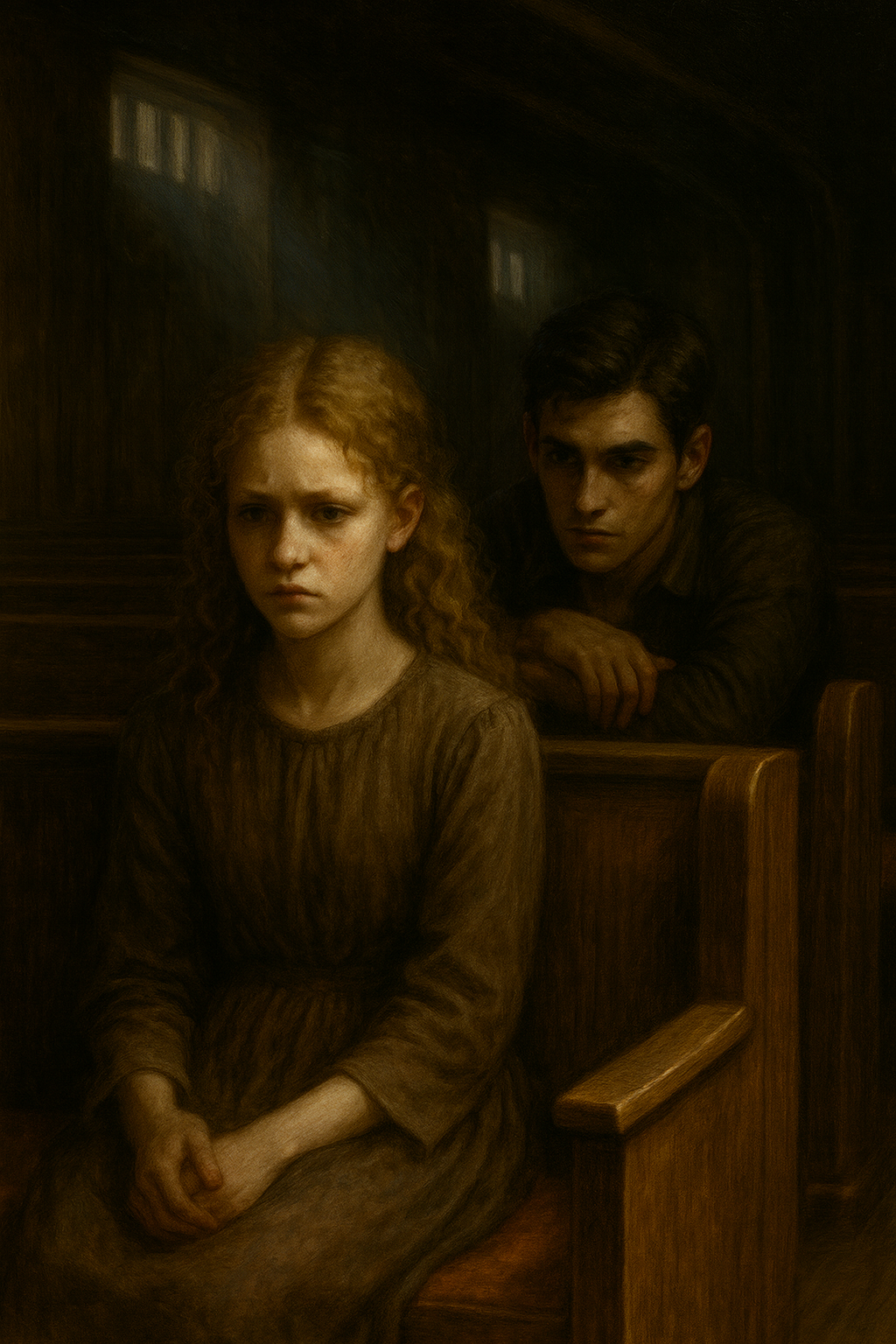
The sanctuary was too cold for August.
Not the type of cold born from air conditioning or the sharp relief of a shaded room after standing too long in the Oklahoma sun. No—this cold came from something older. Something rooted. It rose from the cement foundation, settled into the wooden pews, and wrapped itself around spines and ribs like a second skin. A still, unmoving cold. One that made your joints ache if you sat too long. The kind of cold that belonged to catacombs, not sanctuaries.
The Church of the Firstborn called it sacred air. I called it a warning.
I sat on the third pew from the front, back straight, hands folded in my lap, every inch of me arranged in the posture expected of a devoted daughter. My dress stuck to my thighs with a film of sweat, but I didn’t dare move. The pew beneath me, worn smooth from decades of obedience, had once carried the imprint of my childhood—when I was small enough to swing my feet, wide-eyed enough to believe the silence meant holiness instead of fear.
We built this church ourselves. The men cut the timber from neighboring farms, the boys sanded every beam smooth, the women sealed the grain with stain that sunk into our skin and refused to come out. I was nine the summer we finished. I’d spent three days scrubbing my hands raw, trying to erase the dark varnish under my nails. It didn’t budge. That was when I first learned that faith—real faith, the kind they asked of us—left stains that didn’t wash off.
I kept my eyes forward now, neck stiff. Every creak behind me sent a fresh stab of tension down my spine. The silence wasn’t passive. It was heavy. Watchful. Not absence, but presence. A held breath that stretched too long.
And beneath the sleeve of my right arm, pressed tight against my skin, the Spiral pulsed once.
Not visibly. Not with heat or sound. But in that way it did sometimes—when fear bloomed too fast, when something nearby woke it. It wasn’t pain. Not exactly. Just pressure. A memory beneath the skin. A quiet reminder.
I curled my fingers into my palm and adjusted the cuff of my blouse with a motion so casual it looked like nothing at all.
The Spiral on my wrist had never faded. Carolyn said it might when I was small. Said baby skin had a way of healing over things. But it didn’t. It stayed. Pale now, mostly. Dormant. But still there. Still real. A mark of something the Church would never forgive if they saw it. A symbol older than their texts. Deeper than their fire.
I’d learned to hide it before I learned to spell my own name. Learned how to breathe through the fear when it glowed cold in the dark, how to roll down my sleeves even in July, how to lie with a soft voice and steady eyes.
Especially around the Elders.
I wasn’t alone in the pew. Jasmine sat to my left, knees locked together, hands clenched in her lap with knuckles bleached white. Her red hair had been ironed into obedient straightness, parted precisely down the center. Her expression was blank, but I could feel her tension bleeding into the wood between us. Her whole body hummed like a wire pulled too tight.
She elbowed me once earlier, subtle, like she wanted to whisper something. I didn’t look at her. Wouldn’t. Not until it was safe.
Behind me, Greg shifted in his seat. He hadn’t said a word—not since we entered. None of us had. Not with the Elders’ eyes behind the walls and the Prophetess’s screams still echoing in the air from last Sunday.
But I felt him.
Even without turning, I could feel Greg’s presence the way you feel a scar after too many years—part of your body, always under the surface. He had been there for everything. The hayloft summers, the baptisms in muddy water, the whispered prayers and the nights we cried without sound. He had held my hand the night his mother died. Had sat beside me in the barn afterward, silent and broken.
A soft tap against the back of my heel.
I didn’t flinch. Just slid my foot back slightly until I felt it.
A gum wrapper. Folded twice. Pressed flat.
Greg’s signal.
I nudged it closer with my shoe, waited for Jasmine to shift beside me, and slipped it into my hand. I unfolded the silver square with practiced care, eyes fixed forward.
Two words. Slanted handwriting. Familiar.
You okay
No punctuation. No flourish. Just Greg.
I didn’t respond. Couldn’t. Not here. Not when silence this thick could hear everything.
But the note sat heavy in my palm.
Ahead of me, my mother sat two pews forward, her back straight as an iron rod. Her dark hair was pinned into a severe bun, and her hands rested on her knees like she had been born a statue. She never turned. Not even when children cried or the Prophetess wailed or the air inside the sanctuary changed.
My father sat beside her, equal in stillness but not in silence. His fingers tapped the side of the pew with slow precision.
One-two-three. Pause.
One-two. Pause.
One-two-three.
When I was a child, I thought it was Morse code. That he was trying to tell me something.
Now I knew better. He was praying.
Another scrape against my heel. Another gum wrapper.
Tracy too?
My breath caught. I folded the note into my fist.
He knew. Of course he knew.
Greg always saw what others missed—even when I tried to hide it. He noticed things. The twitch in a teacher’s smile. The bruises hidden beneath sleeves. The way Tracy Dove had stopped making eye contact two weeks ago, then vanished altogether by Tuesday.
He didn’t ask if I knew.
He didn’t have to.
I reached out and let my pinky finger graze the edge of the pew, just once. Quiet. A reply without words.
Greg exhaled behind me—soft, barely audible. But I could feel it. Not relief. Something darker.
The sanctuary lights flickered slightly as the clouds outside thickened. The sun had been brutal when we walked in—August heat rising off the asphalt in waves—but now, the windows bled grey light down the walls. Long shadows crawled across the floor, inching toward us like hands reaching for ankles.
The windows themselves were set too high to see out of. That was by design. The Elders said the outside world was temptation. That we must resist distraction during worship. That separation was sacred.
But to me, those windows looked like prison slits. Just wide enough to know the sky was still out there. Just narrow enough to forget what freedom felt like.
Another note slid forward. Slower this time.
Look at me if you’re scared.
I didn’t.
But my throat ached with the effort not to.
Greg’s leg bounced once against the floorboard. Just once. But I felt the whole pew tremble with it. He did that when something was wrong. Had since we were kids. His body never quite fit the spaces it was given—too restless, too quick to fill with pressure.
He’d never been able to sit still in this room.
Not even before his mother died.
Especially after.
I didn’t have to look to remember the night.
I was eleven. Greg was thirteen. His mother, Ruth, had vanished without explanation during evening prayer. Her seat empty. Her Bible closed. No one asked out loud. Not at first.
By morning, she was gone.
The Prophetess claimed Ruth had “rejected the healing.” Said God had taken her for doubt. Said she’d received the vision before the body was found.
They called it an ascension.
But I saw the bruises under Ruth’s collarbone at the funeral. Saw the way her lips had split beneath her veil. No one talked about those things. Not here.
I had found Greg that night, in the barn behind my grandfather’s field. Curled against the far wall, hay in his hair, arms around his knees. He didn’t cry. His father had forbidden it.
We sat in silence for hours.
Now, here in the sanctuary, he tapped the pew again. A private code. Our old signal.
I’m here.
I shifted, just enough to feel the wrapper in my palm.
He never asked for comfort. He asked for truth.
And the truth was everywhere this morning.
Thick. Heavy. Waiting.
I stared at the pulpit. Empty. But not unoccupied.
Behind it, six chairs lined the back wall. Thrones waiting for judges. Each one carved, identical, except for the center—a taller back, polished armrests. The Prophetess’s chair.
The baptismal curtain behind the pulpit twitched once.
No wind.
No movement.
Just a shift. Like breath behind cloth.
The Elders hadn’t arrived yet. But that didn’t mean they weren’t watching.
They had their ways. Their tools. Their eyes behind doors.
I felt it. The way a bird feels the air shift before a storm.
Another wrapper tapped my foot.
I waited until Jasmine fidgeted with the hem of her dress.
Slid it up.
You saw paper.
My chest tightened.
He meant the newspaper box.
I hadn’t told him. Hadn’t even meant to look. But he saw me hesitate in front of it on Saturday, just outside the diner.
Cindy McNeil’s voice echoed in my memory, low and sharp as a butcher’s knife:
“That man’s gonna burn.”
She’d sat across from me in the booth, coffee pot in one hand, gossip on her tongue like honey mixed with blood.
“Wayne Dove lost it. Beat Gina in front of the shelter. Took the boys. No one’s seen Tracy since Tuesday.”
I hadn’t finished my eggs. Just left cash on the counter and walked out before she could say more.
That’s when I saw it. The newspaper box.
Bent. Dirty. Plastic cracked and sealed with duct tape.
But the front page still visible through the cloudy window.
Another Girl in Southwest Oklahoma Missing.
The photo was black and white. Blurry.
But I knew her.
Tracy Dove.
And now, sitting in this sanctuary, surrounded by people who whispered prayers while ignoring screams, I knew the truth:
Tracy wasn’t missing.
She was taken.
Just like the Spiral on my wrist was never an injury.
Just like the silence in this room wasn’t holy.
Just like Greg’s next note wasn’t going to ask a question.
The wrapper came.
I waited.
Flipped it open beneath my skirt.
Careful.
Two syllables. One warning.
The pew behind me creaked.
Then—
Footsteps.
A ripple of movement passed through the congregation the moment the first footsteps echoed from the side hallway. It wasn’t obvious, not the kind of movement that would draw attention, but it was collective—an entire room straightening, like iron filings caught in the pull of a magnet. We lifted our spines a fraction taller, dropped our gazes, adjusted our posture to the shape of submission. The air shifted again, as if even the walls had begun to hold their breath.
The side door creaked open. Not loudly, but in the kind of silence that amplified every sound like a scream.
Six men entered the sanctuary in single file, their suits charcoal black, pressed flat with the absence of mercy. No one spoke. No one greeted them. Their shoes didn’t make a sound on the thick carpet, and I suspected that wasn’t a coincidence. Even their footsteps were rehearsed. Ritual. As if sound itself bowed to them.
They took their seats behind the pulpit, hands folded neatly in their laps, expressions carved from stone. Each sat in the same position they always had. The center chair, taller than the rest, still empty—reserved for the Prophetess. A throne among judges.
I didn’t breathe.
Behind me, Greg didn’t move.
His father, seated beside him, locked a hand on Greg’s knee so hard I heard the pew groan beneath the strain.
And then came Jon Hester.
He didn’t need a spotlight or a microphone. The man could walk into a room and suck the air out of it with nothing more than the soles of his boots. Sheriff, Elder, executioner in everything but title—he embodied the absolute authority of Rocky. I had never heard him raise his voice, but I’d seen grown men fold in half under the weight of his stare.
He climbed the steps to the platform and turned slowly to face the church. His eyes scanned the pews—calculated, slow, thorough. When his gaze landed on me, I forced myself to remain still. Eyes forward. Shoulders square. No twitch. No flinch. Just a mask, perfectly in place.
His eyes passed over.
I let out a single, shallow breath, the kind you exhale after surviving the click of an unloaded chamber.
Then came the scream.
Not from the pews. Not from a child.
From the Prophetess.
The sanctuary doors exploded open behind us, and Dorthea Riley charged down the center aisle like a thunderstorm wrapped in silk and sequins. Her hands were raised, her body trembling. Her voice pitched high into a wail so sharp it made my teeth ache. It wasn’t singing. It wasn’t speaking. It was some frenzied language only she claimed to understand—ecstatic, divine, and utterly terrifying.
No one moved. No one dared.
She staggered down the aisle, her eyes glazed, robes fluttering around her like smoke. She cried, screamed, whispered, collapsed into ecstatic prayer, only to rise again like a puppet on strings. I felt Greg go still behind me, his body going rigid as if bracing for a blow. He hated this part. Not just because of what it meant, but because he had seen too many of the rehearsals behind the curtain. He’d caught glimpses of the Prophetess in moments when the ecstasy fell away—when the tears dried too fast, when the script peeked through the prophecy.
She stopped just before the front pew, arms trembling.
“God has spoken,” she said, voice raspy with effort. “He has shown me the vessel. The enemy among us.”
The room didn’t gasp. We had long since stopped reacting to these outbursts with shock. Everyone knew what was coming.
She moved again. Slower this time.
Past the first pew.
The second.
The third.
Each step measured. Deliberate.
She stopped at the seventh.
I saw her hand rise from the corner of my vision. Her palm hovered for a heartbeat before descending—slowly, gently—onto the bowed head of the man seated at the end of the pew.
Wayne Dove.
He didn’t resist. Didn’t even blink.
He sat ramrod straight, his shoulders rigid, hands resting lightly on his knees. If he was afraid, he didn’t show it. If anything, he looked resigned. Like he had seen this moment coming long before it arrived.
“It is him,” Dorthea whispered, voice trembling. “He is the stain.”
She turned and ascended to her throne, collapsing into her seat with all the drama of a spirit spent. Her head fell back, her arms limp at her sides.
For a breath, the room held its stillness.
Then Jon Hester rose.
I felt the air in the sanctuary shift—denser, colder, like a wind that pressed instead of moved. He stared at Wayne for a long moment before he spoke.
“Wayne Dove,” he said, voice steady and deep. “Stand.”
Wayne rose slowly, his chin held high. He didn’t shake. Didn’t stutter.
“I did nothing wrong,” he said.
“You defied the covenant,” Hester replied.
“I protected my family.”
“You defied God.”
“I told the truth.”
“You brought corruption. Shame. Fear.”
“I spoke what no one else would say.”
There was something noble in his voice. Something tired, but unflinching. A man who knew he had already lost but wasn’t going to pretend it was a fair fight.
Jon Hester’s expression didn’t change. He didn’t shout. Didn’t threaten. He simply turned to the Elders and asked, “What say you?”
One by one, the six men rose.
“Rejected,” said the first.
“Rejected,” repeated the second.
“Rejected.”
“Rejected.”
Each voice was a hammer striking wood.
“Rejected.”
“Rejected.”
Jon turned back to the church, his voice dropping lower, not with softness, but with weight.
“What say you, Church?”
For a heartbeat, the room held.
Then a voice—female, maybe third row—spoke aloud: “Rejected.”
Another followed. Louder this time.
Then another.
The chant rose like a wave, sweeping through the pews with increasing speed and certainty.
“Rejected.”
“Rejected.”
“Rejected.”
The congregation fell into rhythm, echoing the verdict, solidifying the judgment. Even the children joined. Even Jasmine.
Greg didn’t speak. Neither did I.
Wayne Dove remained standing. His jaw clenched. His eyes wet, but he didn’t cry.
And then the doors slammed open.
Four men entered from the rear. I didn’t know their names—no one did—but they were the kind of men who didn’t need introductions. They didn’t wear suits like the Elders. Their clothing was practical. Workmanlike. Their faces blank.
They moved quickly, decisively. No ceremony. No prayer.
They seized Wayne by the arms.
At first, he didn’t struggle. Then, as they turned him toward the exit, he shouted—voice raw and ragged, like it had been held back too long.
“You won’t get away with this!”
His voice cracked as he twisted against their grip.
“Where’s my daughter?! Where’s Tracy? What did you do to my girl?!”
No one answered. No one moved.
The Prophetess didn’t even open her eyes.
The four men dragged him out of the sanctuary like he was already dead. The doors slammed shut behind them, and the heavy thud of metal locks followed.
Then nothing.
No final prayer.
No benediction.
Just the echo of his screams as they faded down the hallway.
Greg whispered behind me—so softly I almost missed it.
“Tracy…”
The silence that followed wasn’t reverent. It was heavy. Claustrophobic. I felt it press down on my shoulders like weight on a scale, threatening to crush the air from my lungs.
The Elders stood and exited one by one. Jon Hester followed last, his boots striking the floor like punctuation. The Prophetess remained still, her head bowed, her body slack in her chair as if her performance had drained her.
No one moved.
Somewhere nearby, someone cried quietly. My mother’s shoulders were trembling, but she made no sound. My father’s tapping had stopped.
Greg shifted behind me, his foot brushing mine lightly, then again. A signal. I leaned back slightly, pretending to adjust my hair, and felt the warmth of him lean in too. His arms rested across the back of my pew, his forehead lowering until it hovered near my shoulder. Not touching. Not quite. But close enough that I could feel the breath rise from his chest and whisper against my skin.
I moved my hand to my shoulder, brushing my hair out of the way. My fingers touched his—quick, barely there.
It wasn’t an accident. It wasn’t romantic.
It was human.
And in this place, humanity was rebellion.
Jasmine turned to look at me. Her eyes were wide, her lips parted with something between fear and awe. I didn’t return the look. I didn’t need to. We all understood now.
Tracy Dove wasn’t missing.
She had been taken.
By the same men who stood behind the pulpit. The same ones who dragged her father out of the sanctuary. The same church that taught us obedience was salvation—and silence was proof of faith.
Another gum wrapper slid under my heel.
I didn’t rush.
I waited three steady breaths. Then leaned forward and picked it up slowly, careful to keep my movements smooth, inconspicuous. I unfolded the note beneath the fabric of my skirt.
Four words.
The ink smudged from sweat. The lines shaky.
We need to run.
I closed my hand around it, pressing it into my thigh.
The Spiral beneath my sleeve pulsed once. Cold. Final.
And for the first time since I was old enough to kneel—
The Church didn’t feel like a sanctuary.
It felt like a coffin.
And the lid had already closed.