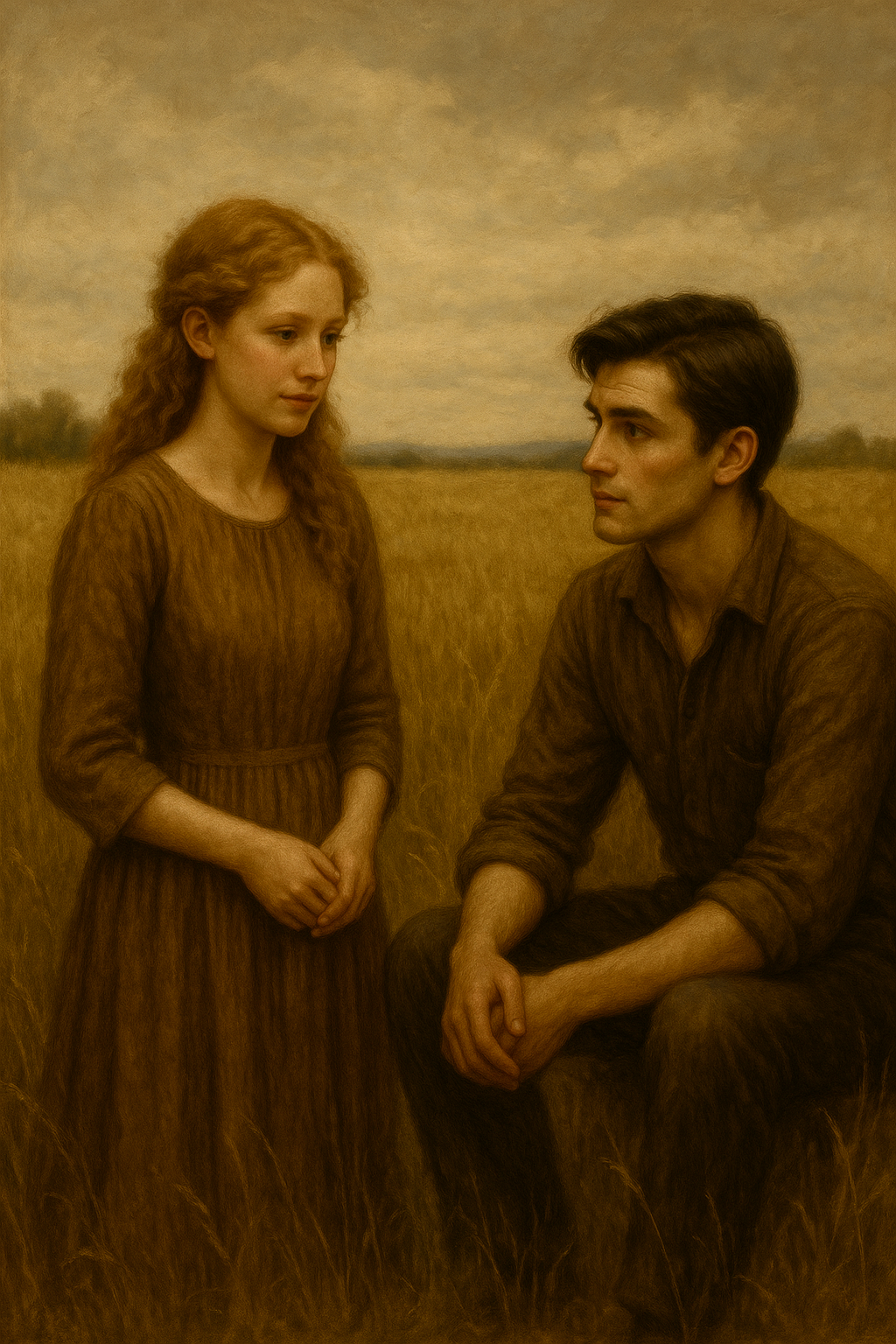
The Firstborn Prophecy: Chapter Two
I didn’t sleep that night.
Not even a little.
Sleep was for safe places. For people who believed what they’d been told, who could kneel with their eyes closed and not feel the ground shifting beneath their feet. Sleep belonged to children, and I hadn’t been one of those in a long time.
Instead, I lay in bed and stared at the ceiling, where the dark pressed so thickly against the rafters it seemed to move. It was the kind of dark that didn’t just exist—it waited. It remembered. The kind that found your breath and held it.
I hadn’t felt this way in years. Not since I was six, huddled under my blanket as something screamed into the bones of the house. Back then, I couldn’t name it. Just a sound, somewhere deep under the floor, not meant for me. A crack in the world I wasn’t supposed to notice.
But the thing about cracks—if you see one once, you always see it again.
And I’d been seeing them ever since.
Now, at seventeen, I understood the weight of silence far better than I had then. I understood how it could settle in a room like smoke, how it could wrap around a body and squeeze until you forgot you ever had a voice. Silence in Rocky wasn’t absence. It was enforcement.
And tonight, it was deafening.
The house creaked faintly with the shift of temperature, old boards groaning under their own memory. Normally those sounds brought a kind of comfort—a sense that the house was still alive, still breathing with us. But tonight, it wasn’t breathing.
It was holding its breath.
Wayne Dove had been taken. Pulled from the sanctuary like a corpse still warm, dragged past pews filled with people who didn’t dare speak his name once the doors slammed shut.
And Tracy…
Tracy wasn’t missing.
She’d been erased.
No one spoke of her anymore. Not in whispers, not in prayer. Her name had become something toxic—too dangerous to touch, too sacred to mourn. The Church hadn’t lost her. It had consumed her.
And I knew it had something to do with Greg.
No one had said it directly. They didn’t have to.
The accusation had already rooted itself in the air the moment Wayne, wild-eyed and trembling, had shouted:
“Tell them what you did with my girl.”
And he hadn’t been looking at Hester.
He’d been staring at Greg.
Greg, who had always been mine in all the ways that didn’t have names.
Greg, who had known me since before I could read a Bible on my own.
Greg, who had once slept beside me in a hayloft and promised that no matter what the Church took from us, we’d always have our stories.
And then there was Tracy.
My first real friend.
The kind of friend who braided your hair and kept your secrets and snuck stolen black licorice into your coat pocket during fast days. We had been inseparable for most of our lives. Everyone said we were born wrong—me two weeks early, her two weeks late—but perfectly timed for each other.
She was the first person I ever told about the Spiral. The first person I ever practiced lying to the Elders with. The one who held my hand the day I had to give my purity testimony in front of the Prophetess and whispered, “Say nothing. Silence is safer.”
And then she kissed Greg.
Or he kissed her.
Neither of them ever admitted who started it, and in the end, it didn’t matter. Because something between us broke the day I saw her laugh in his direction and he smiled back like he meant it.
We never fought—not the kind of fight you can name. But something between us twisted. Bent. Shifted out of shape. And we both pretended it hadn’t.
She stopped sitting next to me in the chapel. I stopped passing her notes. And we both started pretending it was fine.
She never apologized.
And neither did I.
But I think we both thought we’d come back together eventually. That whatever had cracked between us could be mended when the Church loosened its grip on our futures. When we were finally free.
Now she was gone.
And Greg was hollow.
And I didn’t know who to blame.
The sky outside my window had taken on the pale, bruised color of early dawn—the kind of light that used to feel safe but now only made the shadows seem sharper. I pushed back the quilt and stepped onto the cold floor, the boards groaning beneath me as if the house were flinching.
Fall was coming. You could feel it in the way the air moved—restless and dry. Like something was stirring underground.
Downstairs was silent. My father, usually the first to rise, hadn’t started the coffee. My mother hadn’t begun the morning prayer. The whole house felt suspended, as though yesterday’s judgment hadn’t just shaken the sanctuary—it had shaken the walls we lived behind.
As I laced my boots, her voice floated from down the hall.
“Pantry duty after lessons today. Don’t forget.”
Flat. Controlled. As if nothing had happened.
“I’m not going,” I said, louder than I meant to.
A pause.
“…Excuse me?”
“I said I’m not going.”
The hallway creaked.
But I didn’t wait for her footsteps.
I opened the door and walked out into the wind.
The wind hit me like a warning the second I stepped outside—sharp and cold, carrying the scent of turned soil and dying grass. The sky hadn’t yet made up its mind whether to rain or not, but it hung low and heavy, as if waiting for the right moment to break.
I pulled my jacket tighter and headed toward the back pasture, my boots brushing through tall grass still slick with dew. I didn’t know exactly where I was going, but I didn’t need to. My feet already knew the path. So did my bones.
Greg was there, as I knew he would be.
He was perched on the edge of the rusted cattle trough that hadn’t held water in years, one boot propped up, arms resting loosely on his knees. His hoodie was frayed at the cuffs, and there was a tear across the shoulder he hadn’t bothered to stitch. He didn’t look at me as I approached.
“You’re late,” he said.
“I wasn’t sure I was coming.”
“You always come.”
I crossed the field in silence, the distance between us crackling with the kind of tension that had no beginning but too many endings. I sat beside him, the metal cold beneath my thighs, and stared out toward the trees where the boundary fence curved away from the property.
The silence between us wasn’t comfortable. Not anymore. But it was familiar.
He reached down, picked up a rock, and tossed it into the overgrown weeds. It landed without a sound.
“They took him,” he said.
“Wayne,” I murmured.
Greg nodded.
“Dragged him out like he was already dead,” he said. “In front of everyone.”
I looked down at my hands.
“That wasn’t exile,” I said. “That was a message.”
He didn’t argue.
For a while, the wind did all the talking. It moved through the grass like breath. Through the trees like warning.
Then Greg turned to me, his eyes shadowed and tired in a way I didn’t want to name.
“I’ve been thinking about it,” he said. “All of it. You, me. Tracy.”
I didn’t speak.
“We used to be the same story,” he said, voice quiet. “Three of us, always together. Like the world couldn’t touch us if we stayed close enough.”
“We were a braid,” I said, almost to myself. “Three strands. Until one of us pulled away.”
He rubbed a hand across his jaw. “I never meant to hurt either of you.”
“But you did.”
He didn’t deny it.
“I didn’t choose her,” he said, as if that counted for something.
“No,” I said. “But you didn’t choose me either.”
He exhaled, sharp and bitter. “I didn’t know how.”
“She loved you,” I said.
There was no point trying to soften it.
“So did you.”
It was the first time either of us had said it aloud.
He looked down.
“She kissed me first,” he said. “But I didn’t stop her.”
“You wanted to be wanted,” I said. “We all did.”
He flinched slightly, but he didn’t look away.
“She needed someone,” he said. “She was unraveling, and no one else saw it.”
“I did,” I whispered.
He finally looked up.
“Then why didn’t you stop her?”
“Because I thought we’d be fine,” I said. “That it was just one kiss. One mistake. That you’d come back to me.”
Greg’s expression broke then—just slightly. Like something in him caved inward.
“I never left you,” he said.
But I didn’t believe him.
And he didn’t say it again.
When the silence settled again, it wasn’t sharp anymore. It was just… tired.
I reached into my coat and pulled out the notebook. The one filled with things I wasn’t supposed to remember. I handed it to him without a word.
He looked at the worn spine. The dog-eared corners. The ink bleeding through the paper in places.
“You’ve been writing it all down,” he said.
“Everything.”
“That’ll get you caught.”
“I think I already am.”
He flipped through the pages—skimming symbols, sermon fragments, odd names, and rumors. He paused on a date.
“This was the last time she spoke to you?”
I nodded.
“She said she didn’t feel like herself anymore,” I said. “That she kept forgetting things. Losing time.”
“I thought it was just stress,” Greg said. “Wayne said she’d been fasting. I figured she was light-headed. Tired.”
“She was scared,” I said. “And we didn’t see it.”
“We did,” he said. “We just didn’t want to believe what it meant.”
I looked at him.
“She told me something,” he said slowly. “A week before she vanished. She said they’d marked someone. That they were preparing her for something.”
My blood went cold.
“She said there were symbols under the chapel,” he added. “Older than scripture. Older than the Fold.”
He looked back toward the fence line.
“My uncle found blood,” he said. “Under the pulpit.”
And I knew then—we weren’t just remembering her.
We were following her.
The weight of Greg’s words lingered in the space between us, heavy as stone. I felt it in my chest, a pressure building behind my ribs like something trying to claw its way out. The wind had stilled around us. Even the grass seemed to stop rustling, as if the world itself was holding its breath.
“Where did your uncle find the blood?” I asked, though I already knew the answer.
Greg hesitated, then stood. He didn’t look at me right away, just stared across the field like the memory lived somewhere on the horizon.
“Beneath the old meeting hall,” he said finally. “The crawlspace. Said he went down there to check a pipe. Found dried blood pooled against one of the beams. Clumps of hair caught in the woodgrain. Like something—or someone—had been dragged.”
I stood too, my limbs stiff from the cold metal trough. My hands trembled slightly, but I didn’t bother to hide it.
“Why didn’t he tell anyone?” I asked.
Greg turned, and his expression was dark, unreadable. “Tell who, Lucy? The Elders? Sheriff Hester? My uncle knows better than to make noise where silence is rewarded.”
He was right. Everyone in Rocky did. Silence was survival. Obedience was the only language spoken above a whisper.
But we weren’t interested in surviving anymore.
We were done whispering.
“Take me there,” I said.
Greg blinked, then nodded once, sharply. “Come on.”
We moved fast across the fields, cutting behind the learning chamber and past the old Dixon corn rows, now brittle and half-harvested. The husks cracked like dry paper in the wind, their spines yellowing with the first signs of rot. The chapel loomed in the distance, but it wasn’t our destination. Not yet.
Instead, we ducked behind the forgotten structure near the back pasture—the original meeting hall, long since decommissioned but still watched. The windows were blacked out with thick boards. Moss grew in the corners. But the bones of the place were still there, breathing under decades of silence.
“They sealed the front doors a year ago,” Greg said quietly, crouching beside the foundation. “Said it wasn’t safe anymore. But there’s a panel back here they never reinforced.”
He pressed his hands to the warped wood near the crawlspace, fingers finding familiar grooves. The screws were rusted, the edges weather-swollen, but the panel gave way with a groan that echoed beneath the floorboards.
A gap opened. Dark. Narrow. Barely enough space for a child to crawl through, let alone two seventeen-year-olds.
But we didn’t hesitate.
Greg slid in first, the earth swallowing him whole. I followed, the wet dirt pressing against my palms, cold and smelling of mildew and old wax. The silence in the crawlspace wasn’t like the kind outside. It was denser. Still. Like breath held too long.
I kept low, my back brushing the beams overhead as we moved deeper, the only light coming from the narrow cracks between the warped boards above us. It was enough to see shapes. Forms. The outlines of objects shoved into corners and forgotten—broken chairs, crumpled linens, old communion crates that had never made it back to the pantry.
And then I saw it.
The stains.
Blood, dried black into the wood, sunk deep like a wound the floor never healed from. A halo of it darkened the gravel beneath. Not splattered. Not random. Pooled. Thick.
“This is where he found it,” Greg said, voice low.
I didn’t answer. I couldn’t. My eyes had locked on something else.
There were symbols.
Etched in chalk, faint but intricate, scrawled across the floor in tight, deliberate circles. Not the work of a child. Not random doodles or bored scribbles. These were designed. Marked with intent.
I crawled closer, brushing my fingers lightly across the edge of one line. The chalk flaked beneath my skin like it had been waiting to be touched.
“This is a binding circle,” I whispered.
Greg’s breath hitched. “Tracy showed me one once. Said she found it in an old hymnal hidden behind the choir loft. Said it was older than scripture. Older than the Prophetess. Older than everything.”
“She believed it,” I said. “Didn’t she?”
“She knew it,” he answered.
We didn’t speak after that, not for a long moment. The silence around us grew heavier the deeper we stared into the symbols. Like the crawlspace remembered what had happened here.
I turned, shifting toward the far corner of the crawlspace—and froze.
There, buried half beneath a mound of dust and shed insulation, was a denim jacket.
I reached out with shaking fingers and pulled it free.
It was small. Frayed at the cuffs. The kind of jacket you wear every day without thinking. On the right shoulder, a patch had been sewn into the fabric—roughly, but with care. The initials were faded, but still legible.
T.D.
Tracy Dove.
Greg’s breath caught. He crouched beside me, his hand hovering near the fabric but never quite touching.
“She was here,” he said, voice raw. “She hid here.”
I turned the jacket over, and my stomach twisted. The inside lining was stained—dark, stiff, soaked through with old blood.
It hadn’t been cleaned. It hadn’t been taken as evidence. It had been left.
Left like a warning.
Left like a secret.
I cradled the jacket in my arms, pressing it against my chest as if the scent of her might still cling to the denim. Candle wax. Lavender soap. The ghost of someone who used to laugh so loud it startled birds from the cornrows.
I wanted to cry.
Instead, I looked up—and saw it.
On the beam behind the jacket, carved deep into the wood with something jagged and desperate, was a single word:
SUNDER
It wasn’t just a message. It was a scream.
Greg knelt beside me, his voice shaking. “What does it mean?”
“I don’t know,” I whispered. “But I think Tracy wanted us to.”
We were quiet for a beat too long. That was when I heard it.
A sound. Not from us.
A breath.
Wet. Ragged. Just once.
Then again.
Slow. Close.
Coming from the far corner—where the darkness was thickest and the crawlspace narrowed too tight for anything human to crawl through.
I didn’t wait to see.
Greg grabbed my hand, and we scrambled back the way we came, knees scraping the gravel, lungs burning, hearts pounding loud enough to drown out thought. The cold daylight outside hit us like a slap when we burst free from the opening.
We lay in the grass behind the meeting hall for a long time, our chests rising and falling in sync, hands pressed to the earth like we needed proof we were still on it.
I stared at the sky.
It didn’t feel like safety anymore.
We didn’t speak for a long time.
The sky above us stretched wide and dull, the kind of grey that seemed to pull the color out of everything beneath it. I lay back in the dead grass, the brittle stalks pressing into my spine like the teeth of some half-sunken memory. My fingers still clutched the jacket like it could warm me, like it might somehow tether me to a girl I hadn’t realized was already gone until it was too late.
Greg sat beside me, elbows on his knees, forehead resting against the back of one hand. His other hand was stained with dirt and something darker—something that might have been blood. He didn’t wipe it away.
“She used to bring me here,” I said after a while, my voice so quiet it barely belonged to the air. “Back before we were… before everything. This field. This building. We called it the Watchtower.”
Greg glanced over at me, but he didn’t say anything. His silence invited more than it withheld.
“She thought it was haunted,” I went on. “Said she could feel something trapped inside. But she wasn’t scared of it. Tracy never was scared of anything.”
He was still looking at me, but I kept my eyes on the sky. The clouds had started to thin. There was a sliver of pale blue bleeding through, but it felt dishonest. Like the world was trying too hard to look normal.
“She was fearless,” Greg said finally. “But she wasn’t stupid. She knew something was wrong in this place.”
There was something else under his words. Guilt. Grief. Maybe something even heavier.
“Why didn’t you tell me about the kiss?” I asked, not turning.
He was quiet for too long.
“I didn’t think it mattered,” he said.
“It did.”
“I know.”
The silence returned, but it had changed now—sharpened. The kind that leaves splinters behind.
“She told me it didn’t mean anything,” I said, my voice tightening around the memory. “But she never looked at me the same after. Not like before.”
“We didn’t mean to hurt you.”
“That’s the problem, Greg. You didn’t mean anything. Not to her. Not to me. You just… let it happen. You always let things happen.”
His jaw tensed, but he didn’t argue. Didn’t defend himself. And in some ways, that made it worse.
“I loved you,” I said softly. “Both of you. In different ways. But it didn’t matter. You didn’t choose either of us.”
“I didn’t know how,” he said.
“I think you did. I think you just didn’t want to.”
A gust of wind swept across the field, lifting the edge of Tracy’s jacket in my lap. I pressed it back down gently, like tucking in a child.
“She was trying to warn us,” I whispered. “Even at the end. She was scared, and she still tried.”
Greg ran a hand through his hair, then sat back in the grass beside me. His shoulder brushed mine.
“We can’t let them erase her,” he said.
“We won’t.”
I went home with the jacket wrapped tight under my arm, hidden beneath my coat. I climbed through my window instead of walking through the front door. I didn’t want to see my mother. Not yet. Not with the blood still on my hands and the memory of that carved word still thrumming behind my eyes.
SUNDER.
I didn’t know what it meant, not exactly. But it felt like something. Like a blade. Like a fracture. Like a prophecy disguised as a wound.
I opened the loose floorboard beneath my bed and slipped the jacket inside, laying it gently beside the notebook I wasn’t supposed to keep. I ran my fingers over the frayed denim, then over the spine of the notebook, feeling the weight of everything I’d written. Every date. Every symbol. Every girl who had disappeared without explanation.
I thought about the blood in the crawlspace. The hymnals. The whispered words of the Prophetess and the way her eyes always seemed too wide when she looked at the younger girls.
I thought about Tracy—my best friend, my first almost-love, the girl who could scream with laughter one second and cut you to the bone with a look the next.
I thought about Greg.
And then I thought about the page he’d shown me before we found the crawlspace.
The one he said came from his father’s study.
I pulled it from my pocket now—creased and yellowed, the ink faded but still legible.
Symbols covered the front. Loops. Crosses. Sharp, unnatural curves that didn’t belong to any language I knew. But the back held something else.
A single line, written in careful script:
What is done in silence, ends in fire.
I read it once.
Then again.
Then a third time, slower.
Something about it stuck to my skin like smoke.
That night, the house felt wrong.
Not haunted. Not exactly. But changed. Off-kilter in a way I couldn’t name.
The walls were too quiet. The floorboards too still. Even the pipes, which normally groaned and whispered their way through the dark, seemed to be holding back.
My mother had already gone to bed, or at least that’s what I told myself. Her door was shut. The lights in the hallway were off. But the scent of bleach still hung in the air like a warning.
I slipped into the kitchen on bare feet, careful to avoid the boards I knew would creak. I poured a glass of water, then leaned against the sink, staring out the dark window toward the chapel.
I hated that it still looked beautiful at night.
Whitewashed wood. Stained glass. A spire that cut the sky clean.
It looked holy. Sacred.
It looked like truth.
But I knew better now.
That place buried things. It fed on silence. On obedience. On girls who asked the wrong questions.
I sipped the water slowly. My hands trembled around the glass.
Then I felt it—again.
The house exhaling.
A shift in the air.
Not wind. Not weather.
Just… presence.
I set the glass down gently and turned toward the hall. I didn’t hear anything. But the silence had shape. Weight. It pressed against my ears like the moment before a scream.
I backed away from the sink.
The boards beneath my heels groaned.
The hallway stayed dark.
And then—her voice.
My mother’s.
From behind her bedroom door.
“You’re drawing attention to yourself,” she said softly.
My throat went tight.
“I didn’t mean to,” I said, unsure if she could even hear me.
There was a pause. Then:
“That’s what frightens me.”
By morning, the frost had crept in fully, brushing the grass in silver and setting a sharp edge to the air that hadn’t been there yesterday. Rocky never eased into its seasons—it turned all at once. Like everything else here, the change wasn’t a transition. It was a command.
The sun had barely risen, a pale smear of light behind thick clouds, and already I could feel the cold threading into the seams of my coat as I walked. My notebook was pressed flat beneath my arm, and inside it—folded between the pages where my handwriting bled and scratched—was the hymnal scrap with the strange symbols and the line I couldn’t stop repeating in my mind:
What is done in silence, ends in fire.
It felt like a message. Or maybe a threat.
Maybe both.
Loretta’s Diner was open, though barely. Half the booths were empty, and the others filled with quiet men in flannel, coffee mugs clutched like rosaries, eyes darting anywhere but mine. The heater clanked in the corner, but the cold had settled too deep in the bones of the place to be undone.
I found Shamae in the far booth, her hoodie zipped up to her chin, hair tucked into a low braid, fingers curled around a mug like it was her only defense against the cold.
She didn’t look up as I slid into the seat across from her.
I didn’t speak, not yet.
She kept stirring her drink, slowly, absently. The spoon scraped the bottom of the ceramic in rhythmic circles, the sound soft but jarring—like she was digging for something buried in the dregs.
“I thought you hated this place,” I said finally.
“I do.” Her voice was flat. “But no one checks the napkin dispensers here.”
She nodded once toward the edge of the table.
I looked.
A folded note—creased down the middle, tucked just beneath the sugar jar like it had always been part of the landscape.
Greg’s handwriting.
Tonight. Midnight. East gate. Bring what you found.
I read it twice, then folded it slowly, carefully. As if handling it too roughly might make it disappear.
Shamae raised an eyebrow. “He thinks he’s subtle.”
“He used to be,” I murmured.
She studied me then, her expression unreadable. But something tightened at the edges of her mouth. A hint of something unsaid.
“He used to be a lot of things,” she said.
The silence between us thickened, but not in the way it used to when we were friends. Not the comfortable hush of shared secrets. This silence had weight. Distance. The kind you had to climb through.
“You never told me,” she said eventually, “that you and Greg were—”
“We weren’t.” I cut her off before she could finish the sentence. “Not really.”
Shamae didn’t flinch, but her stare sharpened. “He told you things. Even when he was kissing Tracy.”
My breath caught.
“He kissed her once,” I said. A lie I’d been trying to believe since the day Tracy stopped looking me in the eye.
Shamae looked away.
“That you know of,” she said softly.
Her voice didn’t carry blame. Just the blunt, weary truth of someone who had stopped protecting people who didn’t protect her back.
“I didn’t know how to stop it,” I whispered. “Any of it. One minute, the three of us were always together, and the next… I was on the outside, watching her wear lipstick that matched her nail polish, and Greg couldn’t stop looking.”
“She loved attention,” Shamae said. “But she didn’t know what to do with it once she had it.”
“She told me he kissed her to prove something,” I said.
“She told me he kissed her because you were too afraid to choose him,” she replied.
The words hit like a slap—not because I hadn’t heard them before, but because Tracy had once said the same thing to me. Late summer. One of our last real conversations before it all fractured.
“You had your chance,” she’d said, voice quiet but clipped. “He was always waiting for you to say it. But you never did. So maybe I will.”
I hadn’t spoken to her for a week after that.
And then she disappeared.
“I didn’t think I had to choose,” I said now. “I thought what we had—all three of us—meant something.”
Shamae looked down at her mug. “It did. That’s what made it worse.”
Outside, a group of younger boys passed the window, laughter too loud, jackets too clean. One of them glanced in, saw us, and looked away too fast.
“They’re watching again,” she said.
“They never stopped.”
She set her mug down and leaned forward, voice low now. Measured.
“She told me something,” she said. “The day before she disappeared.”
My spine straightened.
“She said the Prophetess told her to fast. For seven days. To be ‘emptied before the filling.’” Shamae’s eyes darkened. “I thought it was just more purity class bullshit, but… she was scared.”
I swallowed hard.
“She said they made her stay overnight in the old meeting hall. Alone. And she wouldn’t tell me why.”
The words curled in my stomach like a hook.
“What was she afraid of?”
Shamae hesitated, then reached into her coat pocket. She pulled out a scrap of paper—yellowed, wrinkled, like it had been hidden in the spine of a hymnal for years.
“She gave me this,” she said. “Said if anything happened to her, I had to give it to you.”
She handed it across the table. I took it carefully, my fingers suddenly ice cold.
Symbols.
The same strange symbols I’d seen in the crawlspace. The same angular, looping patterns I was beginning to recognize—not just as language, but as warnings.
And at the bottom, in thick, black ink, one word:
SUNDER.
I stared at it, the sound of it in my head like the crack of a splitting bone.
“She didn’t leave us a trail,” I whispered. “She left us a map.”
Shamae nodded once, then looked away.
“I think we all failed her,” she said. “You. Me. Greg.”
“I know we did,” I said.
But I also knew we had one last chance not to fail what she left behind.
The wind that night came in colder, sharper than before—threading through the compound like something searching for open doors. It hissed against the chapel shingles and rattled the gates in their locks.
Greg was already waiting when I reached the East Gate. His hoodie was pulled up, flashlight in one hand, crowbar in the other. He didn’t smile when he saw me—he just nodded, jaw clenched, eyes grim.
“They’ve started sealing things,” he said. “The chapel. The archive. Even Wayne’s house.”
“How do you know?”
“My dad said it over dinner. Said it was time to ‘clean the record before the next harvest.’”
I stared at him. “The record?”
He didn’t answer.
He just turned and started walking.
The gravel behind the chapel crunched beneath our boots in a rhythm that didn’t feel right—too loud, too exposed. We moved fast but low, ducking past the line of empty dormitories where dim lanterns flickered behind shuttered windows. Above us, the bell tower loomed, its spire slicing into the dark like a blade. Cold wind tugged at our sleeves, bringing with it the faint scent of smoke and iron.
Greg didn’t speak as he led the way, but I could feel the tension coiled in him like a wire ready to snap. He hadn’t been the same since we found Tracy’s jacket. Since he saw the blood. Since he read that word carved into the beam—Sunder—and flinched like it had clawed something open inside him.
He was unraveling.
So was I.
We reached the chapel’s east side, where the newer buildings faded into stone walls weathered by decades of silence and rot. The cellar doors were there—just as we’d left them—chained and padlocked, the metal rusted and streaked with something that looked too dark to be just water.
Greg jammed the crowbar under the lock and gave it a sharp wrench. It didn’t budge.
Again.
This time, with a grunt, the lock gave a sick pop and cracked open. The chain slithered free and dropped to the dirt like a dead snake.
A gust of air escaped the gap beneath the cellar doors.
It didn’t smell like rot.
It smelled like stillness.
That breathless, unmoving kind of air you only find in places that have been sealed too long. The kind of silence that soaks into your skin.
Greg didn’t hesitate. He pulled the doors wide and clicked on the flashlight.
A narrow staircase led downward into dark.
He looked back at me, his face pale but steady.
“You sure?” he asked.
I didn’t answer.
I just followed.
The steps groaned beneath our weight. The air grew colder as we descended, each footfall swallowed by the stone. Greg’s light swept across the cramped space: old shelves stacked with crumbling hymnals, jars of rusted nails, boxes stamped with dates long past. On the far wall, a line of ceremonial robes hung like bodies in a row—white turned grey, the edges tattered, sleeves limp and empty.
We didn’t speak.
There was no point.
We moved along the wall, past a shelf where thick jars held dried herbs and sealed wax candles. Toward the back of the room, the mortar between the stones looked fresher—lighter, less settled. Out of place.
Greg reached forward and pressed his fingers along the line of bricks. One gave under the pressure.
He worked it loose slowly, brick by brick, until he pulled free the last one and reached into the hollow behind it.
A book emerged. Leather-bound, soft-edged from moisture. The cover bore no title. Just a single, jagged burn mark across the spine.
Greg held it like it might bite.
He opened the front cover, and for a moment, we both stood silent as the pages turned beneath his fingers.
The first few were blank.
Then came the words—handwritten, the ink smudged, shaky but deliberate.
They walk among us in robes, but their shadows are not their own.
A chill ran down my back.
Greg flipped to the next page.
There were drawings. Crude maps. Symbols. Lists of names I recognized—some crossed out, some circled. Wayne Dove’s handwriting was everywhere, but it wasn’t neat. It wasn’t calm. It was desperate. Jagged. Scratched like someone trying to get truth out before the darkness closed in.
He turned another page and stopped.
The map.
It looked like the floorplan of the chapel. But it was overlaid with something else—tunnels. Routes. Hidden passages and dead ends. Staircases that led nowhere. Hallways that had long since been sealed.
And one corridor, marked with a red X.
Beside it, in cramped, frantic letters: Tracy.
My breath caught.
Greg didn’t say anything. He just walked toward the far wall—the uneven one. The one the Prophetess always claimed was “blessed stone,” placed there during the founding of the Church.
Now I knew it was a lie.
He set the book down carefully on the floor and raised the crowbar. With slow precision, he scraped it against the mortar until the top layer flaked away like dried skin.
Beneath it, faint but clear, was a smear of dark pigment.
A symbol.
One I recognized.
The same shape traced in chalk in the crawlspace.
The same from the hymnal page.
The same from Tracy’s note.
It pulsed in the light like it had been waiting.
Greg touched it with his bare fingers.
“I think this is it,” he whispered. “This is where it happened.”
I swallowed hard. My throat was dry. My palms slick.
“Greg,” I said, “what if this is where they took her?”
He didn’t answer.
But his fingers were shaking.
He pushed again—harder this time—and a section of the wall shifted inward with a low, grinding moan. Dust exploded into the air. Greg backed up fast, coughing, holding the flashlight high.
Behind the false wall was a tunnel.
Narrow. Uneven. Sloping downward.
The air that poured out wasn’t fresh.
It was warm.
Too warm.
Like breath.
I stared into the dark and felt my skin prickle, every hair rising in warning.
Greg stepped forward.
Then he stopped.
He turned toward me, voice low and strained.
“I should’ve protected her.”
It came out before I could stop it:
“So why didn’t you?”
He flinched. Like I’d hit something that hadn’t finished healing.
“I didn’t know how,” he said. “I thought... I could care about both of you.”
I held his gaze, the pain clawing up my throat.
“But you didn’t choose either of us.”
He didn’t deny it.
Just looked away.
“I was scared,” he said.
“So was she.”
And then, softer: “So am I.”
He looked back at me then, and for the first time since we were kids, I saw him without all the armor. No cocky smirk. No forced calm. Just a boy who’d seen too much and done too little.
“I loved both of you,” he said. “But Tracy… she needed something I didn’t know how to give.”
“And me?” I asked.
“You didn’t need anyone,” he said. “Not back then. You were already building the fire.”
He took a breath, and the silence stretched between us like a thread drawn tight.
“I didn’t want to get burned.”
The words hurt more than I expected.
And yet, something about them felt true.
Maybe I had always been fire. And Tracy had been something else entirely—wind, maybe. Light. Easily scattered.
But now she was ash.
And we were standing in the place where the match had been struck.
I took the flashlight and stepped forward.
“We’re going in,” I said.
Greg hesitated—then nodded, and followed.
The tunnel wasn’t made for people.
Not for living ones.
The ceiling dipped low, forcing us to crouch as we moved. Damp earth pressed in around us, swallowing the light in greedy gulps. The walls weren’t brick—at least, not anymore. They’d begun that way near the cellar entrance, but ten feet in, the stones gave way to packed soil, laced with roots that looked like veins. The kind that still bled sap when broken.
The air grew thicker with each step. Not musty. Not moldy. Just… wrong. Warm, metallic, and faintly sweet, like something rotting beneath perfume.
Greg kept close behind me, his breath brushing the back of my coat. I held the flashlight in both hands, its beam shaking just enough to make the shadows move with us. Like they were pacing us. Measuring us.
“What is this place?” I whispered.
Greg didn’t answer right away.
Then: “Older than the Church.”
His voice was low, hoarse with something between awe and dread.
I didn’t want to believe him. But the further we went, the more I felt it. This wasn’t part of the chapel. This wasn’t part of Rocky.
This was something underneath.
Something before.
And we were walking on its bones.
The tunnel widened.
The air changed.
And then we stepped into a chamber.
Circular. Stone. Sunken like an old coliseum, stairs spiraling down toward a black pool at the center.
Not water.
Thicker.
Still.
At the edge of the pool—robes. White and pale grey. Discarded. Slumped in a pile like skins shed in a rush.
Greg made a sound—low in his throat.
I walked toward the edge.
The pool didn’t reflect.
It absorbed.
And beneath the surface—
A braid.
Dark.
Bound with a red ribbon.
Tracy.
I staggered back.
“No,” I whispered. “It can’t be—”
Greg dropped to his knees beside it. His hand trembled as he reached out—but stopped just before touching.
“I think this is where they bring them,” he said. “The girls. The chosen. For the seventh offering.”
My chest tightened. “Tracy...”
“She didn’t ascend,” he said. “She was given.”
The word echoed off the stone.
And I knew it was true.
The Prophetess had lied.
The Elders had lied.
But the Spiral had always told the truth.
Greg turned to me, something raw in his eyes. “We have to leave. Now. We take the journal. We take the pages. We take everything.”
I nodded.
We backed away from the pit.
But before we reached the door—
A sound.
Low. Inhuman.
Like stone grinding on bone.
From the pool.
From beneath it.
Something moved.
The surface shivered. A ripple bloomed outward. Slow. Controlled.
Greg grabbed my wrist.
“Run.”
We didn’t need a second warning.
We turned and fled, the iron door slamming shut behind us with a sound that rattled the marrow of my spine. The tunnel was too narrow, too slick, but we didn’t stop. Didn’t speak. Just ran, our footsteps a frantic echo of the thing rising behind us.
By the time we reached the cellar, the first light of dawn was bleeding into the cracks of the chapel floorboards.
Greg slammed the cellar doors shut and locked them again.
Only then did we collapse—gasping, shaking, broken open.
“I saw her,” I whispered. “That was her hair.”
He didn’t try to lie.
We sat in the dirt, surrounded by ash and stone and things too old to have names.
Somewhere above us, the sanctuary bell rang.
Not once.
But seven times.
The Fold was waking.
And it knew we were no longer blind.