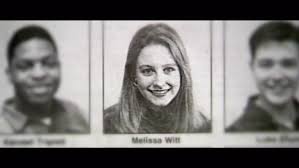
The Man She Knew
On a cold December night in 1994, nineteen-year-old Melissa Ann Witt walked across the dimly lit parking lot of Bowling World to meet her mother for a simple evening together. That short walk — barely a minute from her car to the front doors — should have been ordinary. Instead, it became the border between a life filled with possibility and a tragedy that continues to reverberate nearly three decades later. When Melissa stepped into the darkness of that parking lot, she did not step toward a stranger lurking in the shadows. Everything we know about her case, every behavioral marker and investigative insight, every nuance of the crime scene and the days that unfolded after, points to a far more painful truth: Melissa Witt was killed by someone she knew.
There is a specific kind of violence that occurs when a victim recognizes her attacker. It changes the dynamics of the struggle. It changes the choices the offender makes. It changes what he is willing to risk, how close he is willing to get, and how much time he is willing to take. A random killer approaches with fear of being interrupted. Someone known to the victim approaches with the confidence of familiarity, the ease of proximity, and the subtle authority of emotional access. In Melissa’s case, the evidence has always leaned toward the latter — someone who didn’t need to chase her down or convince her to give him a moment; someone who could get close enough to lower her guard.
Investigators long ago noted that Melissa argued with someone in that parking lot. That detail is often overlooked, but in truth, it is a cornerstone of the case. Arguments do not erupt between strangers in split-second encounters. Arguments happen between people who have something to resolve, some emotional thread connecting them, whether loose or taut. An argument indicates recognition. It indicates familiarity. It indicates the presence of someone who felt entitled to her attention — and someone who believed she owed him something: time, explanation, forgiveness, or submission.
The hyoid bone in Melissa’s neck was broken, the telltale signature of manual strangulation. Strangulation is not simply a method of killing; it is a method of domination. It is close, personal, intimate, and fueled by emotion. It takes time. It requires commitment. It demands face-to-face proximity, the feel of breath and panic and resistance. A stranger rarely chooses strangulation for a first-time attack because it increases risk. A man she knows, one who feels emotionally charged, rejected, humiliated, angry, desperate, or entitled, would choose it. And the person who killed Melissa chose exactly that.
When Melissa’s body was found weeks later in the remote Ozark National Forest, placed first behind a stone and later moved again by the same hands that killed her, investigators saw something that spoke directly to the killer’s relationship with her. Men who return to a body do so because the act is not finished for them. They are drawn back by guilt, longing, obsession, ritual, or the need to reclaim the emotional moment. A stranger with no personal connection rarely returns to a murder scene; returning increases the chance of discovery and does nothing emotionally for someone whose victim meant nothing to him. But for someone who knew Melissa — someone who felt connected to her — the return is a gravitational pull. He did not just want to kill her. He wanted to possess the narrative of her loss.
The placement of Melissa’s body behind a large stone is another detail that aligns with someone she knew. This was not careless abandonment. It was intentional. It suggests a moment of hesitation, conflicted emotion, or an attempt to hide her respectfully while still discarding her. When killers know their victims, their actions reveal a strange blend of intimacy and brutality. They want to control but also to manage their guilt. They want the victim gone, but cannot let them go. They punish, but they mourn. They dominate, but they fear what they’ve done. That conflict is carved deeply into the landscape of this case.
Melissa’s diary — the pure, honest record of a nineteen-year-old navigating friendships, relationships, hurt feelings, disappointments, and hopes — contains names of those who moved through her life during that season. It is within those handwritten entries that investigators have long believed the truth quietly sits. There is no single smoking gun within the diary, no confession hidden between the lines, but there are patterns: people who mattered, people who upset her, people who wanted more from her than she wanted to give, people she trusted, people she forgave, and at least one person she may have felt conflicted about. Diaries do not solve murders, but they reveal emotional ecosystems — and Melissa’s ecosystem contained individuals capable of love, jealousy, misunderstanding, fixation, and resentment. It is within that emotional landscape, not in the shadows of a parking lot, that her killer took root.
The notion that Melissa was killed by someone she knew is not mere theory. It is supported by the totality of the evidence. The abduction was swift but not frantic. The attack was personal and prolonged. The disposal was deliberate but emotionally strained. The return to the body was intimate and obsessive. These are not the actions of a drifter or a passing predator. They are the signatures of a man who knew her face, knew her voice, and perhaps believed himself entitled to her time or affection. In cases like Melissa’s, offenders often experience a trigger — a rejection, a perceived insult, an argument, a moment that shatters the offender’s fragile internal equilibrium. When that happens, the violence that follows is not random. It is relational.
The man who killed Melissa Witt did not materialize from the darkness. He walked into that moment from the pages of her life. He was someone who had access to her world, someone who crossed her emotional orbit, someone whose presence would not have immediately struck her as dangerous. He may have been someone she trusted in small ways, someone she tolerated out of kindness, or someone she tried gently to distance herself from. People around her would have known him, spoken to him, interacted with him, perhaps even dismissed him as harmless. But in the depths of his private mind, something darker was growing.
Men who commit murders like Melissa’s often live behind two faces: the outward persona, which is polite, friendly, responsible, or socially unremarkable, and the hidden self, which is insecure, jealous, resentful, and increasingly unable to tolerate the idea of losing control. In that hidden self, love becomes possession, interest becomes fixation, and disappointment becomes rage. That kind of psychological fracture makes the offender feel invisible, overlooked, or unimportant — until violence gives him the power he feels entitled to.
That is why Melissa’s killer acted with both ferocity and tenderness, both domination and hesitation, both cruelty and care. He wanted to punish her, but he also wanted to preserve something of her. He wanted to silence her, but he did not want to let her go. He wanted to eliminate the problem as he perceived it, but he also wanted to revisit the emotional moment he created. He did not walk away from Melissa’s death; he carried it with him.
What makes this case so heartbreaking is that Melissa would never have suspected the person capable of hurting her. She was kind, open-hearted, and trusting in ways that made her vulnerable to someone who harbored feelings she could not have anticipated. Her diary reflects a young woman who approached life with sincerity and hope, not fear or suspicion. People like Melissa believe in the goodness of others. People like her killer exploit it.
For nearly thirty years, the man who murdered Melissa has lived with the knowledge of what he did. He has aged, changed, adapted, and constructed new versions of himself to present to the world. But the violence he committed did not evaporate with time. It left a mark on him, even if no one around him has ever seen it. Men who kill people they know rarely shed the psychological skin of that act. They carry the weight of memory differently from strangers who kill strangers. They hide it deeply, but it leaks through their lives in places they cannot fully control: relationships that fail inexplicably, temper that flares without cause, obsessions that reignite, addictions that linger, and moments when their face changes at the mention of the victim’s name.
The truth is this: the man who killed Melissa Witt was not a phantom. He was not a faceless predator. He did not disappear into the night. He existed in her world, moved among her friends, crossed paths with her family, and lived close enough to insert himself into her life. He is someone whose presence would have meant something to her, whether small or significant. Someone she wrote about. Someone she spoke to. Someone she recognized.
The reason this case has been so difficult is not because the killer is unknown. It is because he was known.
And while time may have passed, while faces have aged, and while life has reshaped the people who once filled the pages of Melissa’s diary, one truth remains unaltered: someone who knew Melissa Witt killed her. He knows it. Investigators know it. And somewhere, beneath the layers of his carefully crafted life, he fears the moment the truth finally emerges.
For all the years he has tried to hide behind normalcy, silence, and the distance of time, the investigation continues to narrow the space around him. His anonymity is slipping. The truth is quiet, but it is relentless. And the day is coming when the man Melissa once knew — the man she had no reason to fear — will finally be seen for who he truly is.
To the man who took Melissa Witt’s life: you have lived with the truth of what you did for nearly thirty years, carrying it through every version of yourself you’ve built since that night. You have hidden behind time, behind silence, behind the fragile belief that your secret is safe because you buried it deep enough. But nothing remains buried forever. The investigation has never stopped. The people who loved Melissa have never stopped. You may think you’ve escaped consequences, but justice has a long memory, and so do those who continue to pursue it. Wherever you are, however you’ve tried to reshape your life, know this: the truth is moving toward you. And it is not finished.
To the individuals who have tried to derail this case — the ones who lied, distracted, interfered, or tried to insert themselves into a tragedy that never belonged to them — every attempt to muddy the truth only sharpened our focus. Your noise never changed the signal. Your efforts to twist the narrative did not stall the investigation; they revealed your motives, your insecurities, and your irrelevance to the real work being done. You failed to silence the story. You failed to obscure the facts. And you failed to stop the people who refuse to give up on Melissa.
And to the readers, supporters, and every person who has stood beside this case with compassion and determination: thank you. This journey has been long and heavy, but your willingness to keep Melissa’s name alive matters more than you may ever realize. Writing about her is not a task I take lightly. It is an honor, a responsibility, and a promise — to her memory, to her family, and to the truth that still waits in the shadows. If you hold even the smallest piece of information about what happened in 1994, please come forward. Sometimes the detail that seems insignificant becomes the key that unlocks everything.
For Melissa Ann Witt — whose life mattered, whose story endures, and whose justice is still possible — this work will continue until the final answer is found. And it will be found.
—LaDonna Humphrey