The Woman Who Knew Too Much
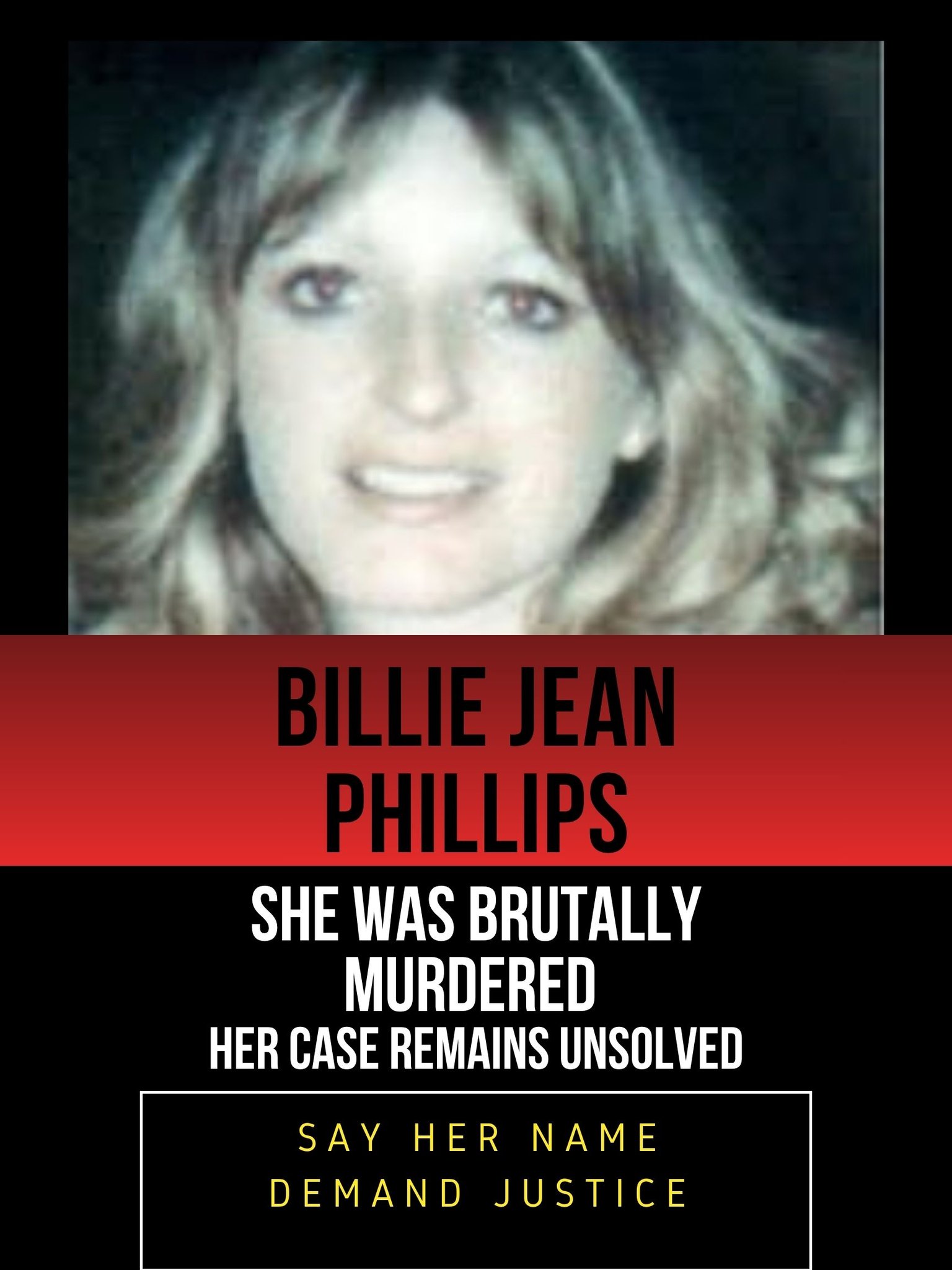
Billie Jean Phillips lived the kind of life people whispered about in grocery store aisles and low-lit bars.
By the time she was 35, she had walked through three marriages, left a trail of furious wives and obsessed men, and brushed up against death more than once. In early September of 1994, death finally caught up with her in the bedroom of her small yellow house just outside Huntsville. Whoever killed her walked away, disappeared back into Madison County life, and has never been held to account.
But if they thought killing Billie Jean would put an end to the trouble she could cause, they misjudged her. Her story is still echoing through this county, and the questions surrounding her death refuse to fade.
Billie Jean came from the McKnight family—hard-working, rooted, churchgoing people. She inherited their drive, but not their quiet ways. From the time she was a teenager, she seemed determined to live life out loud, on her own terms, and mostly in defiance of the rules everyone else tried to play by.
At 15, her father caught her with a state trooper in his patrol car, and there was nothing official about why she was there. That relationship dragged on into her twenties, even overlapping her first marriage. It was the beginning of a pattern: Billie Jean tangled herself up with men who wore badges, men with reputations, men with secrets to lose.
Billie Jean didn’t hide what she was doing. If anything, she doubled down. People in Huntsville still talk about the way she bragged she would bed every lawman in the area, making a mental checklist and ticking off each name. Pretty, fiery, sharp-tongued, she drew men in and left their wives seething. When warnings and cold shoulders didn’t work, she’d sometimes just pick up the phone and announce herself.
And it wasn’t only police who had reason to be nervous. Billie Jean was known to say she had a briefcase full of dirt on “important men” in Madison County—details about affairs, drugs, and backroom dealings. Whether that briefcase ever really existed hardly matters. Enough people believed it did.
Her relationships were rarely simple, and sometimes they were deadly.
Her first husband, Randall Wayne Sharp, married her in a way that fit both of them—on the diving board at a friend’s swimming pool. It didn’t take long for the fights and volatility to take center stage. He could be just as rough and mean as she could be cutting. At one point he tied her up and shut her in the closet so he could head out and gamble in peace. When the marriage began to fall apart, Sharp headed north to work on the Alaska pipeline.
In December 1979, Sharp came home to Huntsville and checked into a room at the Jan-Ran Motel. Billie Jean and her younger brother Robert went to see him. A friend who’d been hanging around with Sharp noticed that he wasn’t exactly thrilled to see her at his door. Before long, only Billie Jean and Sharp were inside the room.
A single gunshot cracked through the motel.
When police got there, Sharp was lying on the bed with a bullet wound to the right side of his head. Billie Jean was holding him, sobbing, telling anyone who would listen that she loved him. He was taken to the hospital but didn’t survive.
Tests later showed gunshot residue on both of Sharp’s hands, heavier on the right palm and index finger. An investigator from the Arkansas State Police concluded that he had likely fired the weapon himself. The Madison County sheriff at the time floated a theory that Sharp had been “pretending” to shoot himself and pulled the trigger on a gun he didn’t realize was still loaded.
Not everyone bought it. Sharp was left-handed and knew guns well. His family and the Huntsville police chief openly questioned the idea that he’d shot himself that way, or that he would have put a loaded weapon to his head at all. A friend also contradicted the sheriff’s version, saying the clip had been removed from the gun only after the shot, by him.
Billie Jean reportedly tested negative for gunshot residue. She was never charged. Behind the scenes, the chief would later say he was told—by the sheriff and the deputy prosecutor—to leave the case alone. The file was closed.
The sheriff, by his own admission, considered Billie Jean a good friend. The deputy prosecutor—let’s call him John Smith—would go on to become far more than that. According to her family, it was around the time of Sharp’s death that Billie Jean and Smith began a long, tangled affair that would continue, on and off, for years. Smith would later prosecute cases tied to Billie Jean’s circle while also representing her in private matters and, by some accounts, sharing her bed.
Sharp’s relatives were furious. His daughter threatened Billie Jean in the wake of his death. The mistrust and bad blood never went away.
After Sharp died, Billie Jean went back to her parents’ home. Grief and fear clung to her. Her sister Euna would later say Billie Jean had nightmares so bad she’d often crawl into bed with their mother and father just to feel safe. But she didn’t stay still for long.
Her second marriage, to truck driver Dale Harp, seemed doomed from the outset. Harp later said he believed she married him for his paycheck, only to discover he didn’t make nearly as much as she thought. Money was a regular sore spot, but the deeper wound was her sharp tongue. She knew how to hurt a man with words and didn’t hold back.
“She could cut you so low it would take a stepladder to climb onto a matchbox,” Harp said later.
At one point, during a particularly vicious fight, Harp found himself holding a gun to her head. It echoed the dynamic from her first marriage, only this time the weapon didn’t go off. Eventually, the marriage fizzled. Harp said he never stopped caring for her, but caring wasn’t enough to live with her.
Her third husband, Charles “Chic” Phillips, worked as a federal poultry inspector. The match brought a new kind of friction. Chic loved her deeply, but he wasn’t interested in playing the game most of the other men in her life played. When she lashed out or stepped over the line, he didn’t shout, hit back, or cling. He quietly walked out. Sometimes that silence was worse than any fight.
For a time, it looked like she might settle into marriage and motherhood. She and Chic had a son. On paper, at least, it was the most stable of her relationships. But the past has a way of showing up, and John Smith’s wife—and the women connected to other men in Billie Jean’s orbit—weren’t done with her.
The marriage to Chic ended in divorce on July 1, 1993. Not long after that, Billie Jean’s life intersected with death again.
In early July 1993, she was riding with a friend, Thomas Garrett, and Kristi Box, the daughter of a well-known Huntsville doctor. They’d been partying. The three of them piled into a car. At some point, the car crashed. Kristi was killed. Garrett and Billie Jean were badly hurt. By the time law enforcement arrived, Billie Jean was gone—someone had picked her up from the scene. It was John Smith who later drove her to a hospital in Fayetteville.
Garrett was charged with negligent homicide, and who signed off on that charge? John Smith—acting in his role as deputy prosecuting attorney. At the same time, as a private attorney, Smith represented Billie Jean in a civil claim and secured a $21,000 insurance settlement on her behalf. Her mother later said roughly half of that was intended to cover medical bills and legal fees. That settlement landed just a couple of weeks before Billie Jean was murdered.
People in Huntsville noticed. A prosecutor who had been around her first husband’s suspicious death was now intimately involved in the aftermath of another fatal wreck tied to her. And he didn’t just appear in courtroom records—her family believed he was still spending time with her privately, long after his own wife had begged him to cut ties.
In the days before her death, Billie Jean told her mother she had taken out a safe deposit box at Madison Bank and Trust. If anything happened to her, she said, her mother was to go there and retrieve a single sheet of paper. She never explained what was on it. After she was killed, no such box in her name was found. Another box, however, was discovered—this one held jointly in the names of John Smith and Billie Jean. Inside were two neat stacks of hundred-dollar bills totaling $20,000. Smith, a member of the bank’s board, quickly claimed the money belonged to his son.
Her sisters also remembered something else: in the weeks before she died, Billie Jean had started talking about a major drug bust that was supposedly about to go down. Madison County was neck-deep in meth at the time. She knew the dealers and the users. She also knew the officers who were supposed to be cleaning it up—and some of those officers, it would later turn out, weren’t exactly on the right side of that line.
Her younger brother Robert was locked in that world and struggling to get out. Billie Jean nagged him to get clean and often paid his drug debts when he couldn’t. He told investigators that one dealer had beaten him up over money not long before the murder. He couldn’t shake the fear that his problems might have drawn danger to his sister’s door.
On Saturday, September 3, 1994, Chic brought their young son back to her little yellow house. It was close to noon. The boy ran inside, then quickly turned back and ran out, alarmed.
“Mommy fell painting,” he told his father.
Chic walked into the bedroom and stepped into a nightmare. There was no fallen paint can, no spilled roller tray. The walls, floor, and bed were smeared and splattered, not with paint, but with blood. Billie Jean lay dead. It was brutal, intentional, personal.
Chic rushed their son back to the truck and tore off to try to find her family. Eventually he reached her parents at the Ozark Shoppe, the convenience store they operated. Calls went out. The sheriff’s department was notified. An investigation began—one that still hangs over Madison County like a storm cloud that never quite breaks.
Who killed Billie Jean? Was it a jealous wife finally pushed to the brink? A lover with too much to lose? Someone tied to drugs who thought she knew too much? Someone wearing a badge?
Her life was loud, messy, and dangerous. She crossed lines and held grudges, collected secrets and made enemies. But that doesn’t change what she was in the end: a woman slain in her own home, in broad daylight, in a county where far too many people still know far too much and are saying far too little.
The question that haunted Huntsville in 1994 is the same question we’re asking now:
Who walked out of that blood-soaked bedroom and slipped back into Madison County like nothing had happened?