What a Landmark Report Reveals About Missing and Murdered Indigenous Women & Girls
I’ve spent years listening to families, combing through databases, and asking uncomfortable questions about who gets counted and who gets remembered. A new analysis underscores something many Indigenous families already know: the crisis of Missing and Murdered Indigenous Women & Girls (MMIWG) is not confined to reservations. It is also an urban crisis—and our systems are failing to see it, track it, or respond to it.
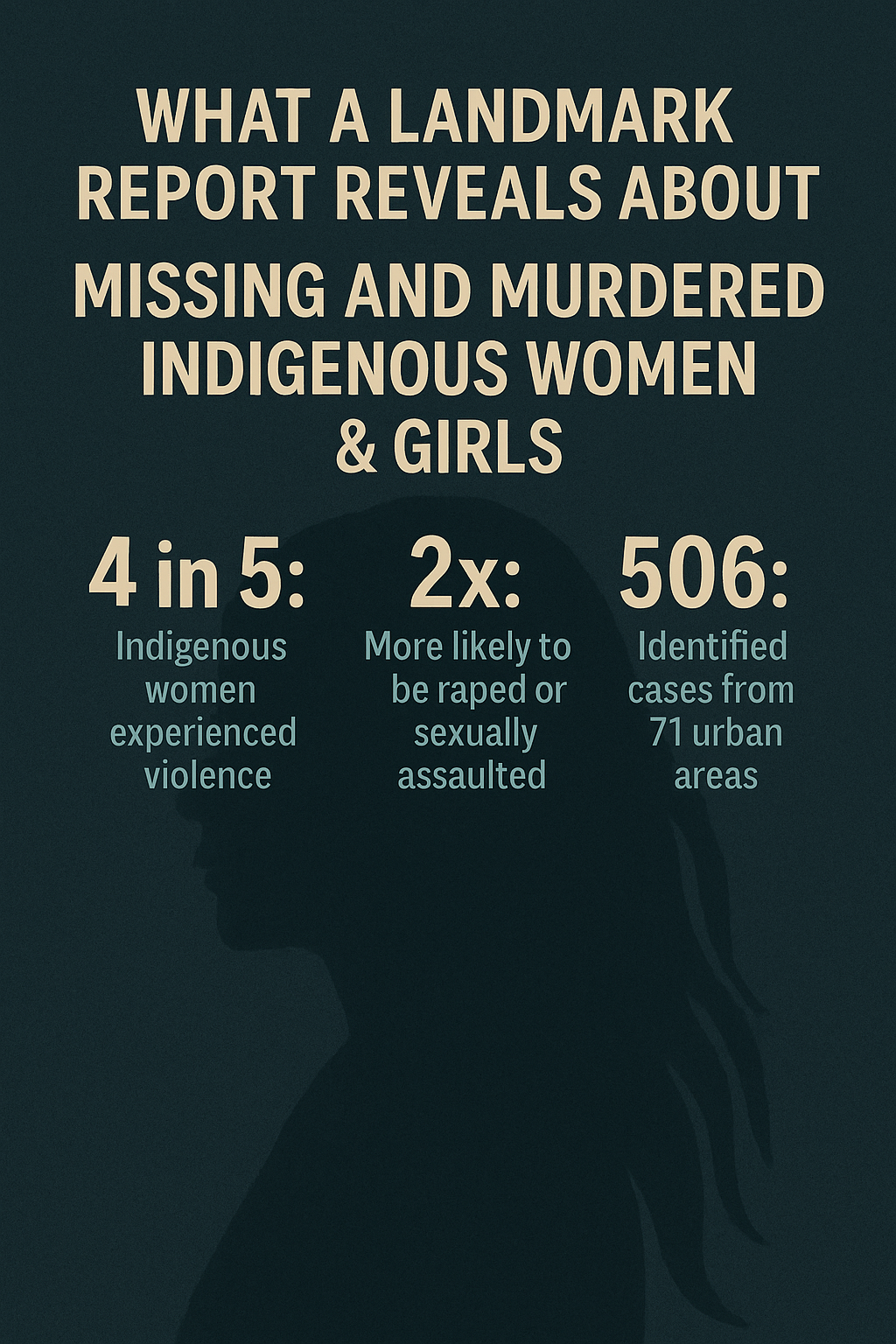
In 2016 alone, the FBI’s National Crime Information Center recorded thousands of reports of missing American Indian and Alaska Native women and girls. Yet the federal missing-persons system (NamUs) reflected only a fraction of those cases. Public health data, meanwhile, shows homicide as a leading cause of death for Native women. These statistics don’t just hint at undercounting; they confirm it.
Researchers with the Urban Indian Health Institute (UIHI) set out to map what’s actually happening in U.S. cities. They surveyed dozens of cities across nearly 30 states and identified hundreds of unique cases of missing and murdered Indigenous women and girls—a number they call a likely undercount due to poor data collection and access barriers. About two-thirds of the cases occurred within the last decade, which points to recent, not historical, failures.
What emerges is a nationwide picture with urban hotspots that rarely make national news. The highest case counts included states such as New Mexico, Washington, Arizona, Alaska, and Montana, with cities like Seattle, Albuquerque, Anchorage, Tucson, and Billings leading the list. These are not isolated anomalies—they are patterns.
The human details matter. Of the cases UIHI identified, a quarter were missing-person cases, more than half were homicides, and the remainder had an “unknown” status. Victims ranged from infants to elders in their eighties, with an average age around 29; more than a quarter were 18 or younger. These are daughters, aunties, grandmothers. They are not statistics; they are stolen lives.
The report also documents risk contexts too often flattened into stereotypes. Cases tied to domestic violence, sexual assault, and trafficking appear throughout the dataset. Some victims were trans women. Some deaths occurred in police custody or involved police brutality. Where relationships to perpetrators were known, partners or family members accounted for the largest share; serial offenders were also present. And in far too many cases where a perpetrator was identified, accountability never followed.
If you’re wondering why we don’t already have clean numbers and clear answers, the methods section reads like a case study in institutional failure. UIHI filed records requests across its city sample. Some agencies were responsive; many were not. Several couldn’t search their systems by race. Others misclassified victims or removed online posts once someone was “located,” with no public note about whether the person was found safe or deceased. This isn’t just a paperwork problem. When a system can’t even search for “Native American” or “Alaska Native,” it erases people in the very databases designed to protect them.
One stark finding: UIHI documented more than a hundred cases that did not exist in law enforcement records at all—cases the researchers uncovered through media, social media, databases, and families. In other words, women disappeared twice: once in life and again in the data.
Even when law enforcement records exist, the public may still be left in the dark. Some jurisdictions remove a missing-person listing when someone is “located” without any indication of the outcome. That gap leaves communities guessing and undermines public awareness.
Media coverage compounds the problem. UIHI reviewed nearly a thousand articles and found that only about a quarter of cases received any coverage—most of it focused on homicides, with very little sustained reporting. Worse, many outlets used harmful, victim-blaming language that stereotypes victims and discourages empathy. The result is an incomplete and biased public record that fails families and frustrates justice.
What does better look like? Practical fixes exist: update record systems so agencies can accurately track race and case status; end practices that silently purge public information; improve interagency cooperation; and resource Indigenous-led research and advocacy. Crucially, respect tribal sovereignty in data—tribal nations should be notified, consulted, and granted access when their citizens go missing or are killed in urban jurisdictions. Without accurate, transparent data, policy solutions are guesses, and families are left to conduct their own investigations.
For readers asking, “What can I do?”—start locally. Ask your city’s police department what race categories their records systems can search. Press for a public dashboard that tracks missing and murdered Indigenous people with clear status updates, not silent takedowns. Support Indigenous media and organizations doing this work. Share accurate case information that directs tips only to official authorities. And remember that this is not just a matter of counting cases; it’s about whether a daughter’s face shows up in the system at all.
If you love someone who’s still missing, you shouldn’t have to fight your way into the data. You shouldn’t have to correct your loved one’s racial designation. You shouldn’t have to beg a newsroom to use her name. We can change that—by insisting on systems that see Indigenous women clearly, count them accurately, and pursue their cases relentlessly.
Sources (UIHI, “Missing and Murdered Indigenous Women & Girls: A Snapshot of Data from 71 Urban Cities in the United States,” Seattle Indian Health Board).